
You have a week or two in France. You want to speak more French by the time you leave. Search for an “immersion course” and you will find everything from a packed school timetable to a teacher’s homestay, a cultural holiday or a château retreat. The photos may look equally tempting. The days will feel very different.
The useful question is not “Which is the best French immersion programme?” It is “Where will I actually use French, and will that practice help with the conversations I care about?” If you want to prepare for a language exam, you may need structured teaching and correction. If you want to chat at a market, ask questions in a village or feel less like a spectator in France, you may want guided practice outside a classroom too.
This guide compares the main formats, 20 real places to investigate, and the questions worth asking before you book. It is written for adults at different stages of life, including people returning to French after decades away from a classroom.
Quick answer: For maximum timetabled study, start with an intensive school. For individual correction and conversation, investigate a teacher homestay or private immersion. For a week combining guided French with local life, consider a residential culture programme or retreat. Ask every provider exactly what happens after class, what is included in the price and who you will speak French with.
French immersion in France for adults: compare the five main formats
“Immersion” has no single timetable. A course can teach French in France while leaving the rest of your day in English. Another may have fewer formal lessons but give you supported chances to speak at meals and on outings. Neither model is automatically better; they answer different needs.
| Format | What a typical day can offer | Especially useful if you want… | Ask before paying |
|---|---|---|---|
| Intensive language school | Level-based classes, set curriculum, perhaps workshops; your own plans after class | Regular teaching, grammar, feedback or exam-oriented study | Are “lessons” 45 or 60 minutes? What happens outside class? |
| Teacher homestay | Private lessons plus shared daily life with a host teacher | Personal correction and sustained conversation | Who else lives there? Which meals and outings are in French? |
| Residential language school | Classes, meals and some activities in one place | A more organised week without arranging every detail | Is accommodation onsite? Which activities are guided in French? |
| French and culture retreat | Guided language sessions linked to markets, food, villages or creative activities | Practising useful French in a small group while enjoying a place | How much is teaching, how much is free time, and what level suits the group? |
| Private lessons plus an independent stay | One-to-one sessions around your own trip | Flexibility and French relevant to your specific plans | Will you create opportunities to use it between lessons? |
One way to compare offers is to divide your week into taught French, supported practice and independent exposure. A lesson hour is a lesson hour. A restaurant visit in French can be valuable, but it should not be counted as an hour of individual instruction. And merely hearing French around you is not the same as having a conversation.
Before you book: Ask for a sample Monday-to-Friday schedule. Highlight the moments when you are expected to speak, the moments when a teacher can help, and the time you will organise yourself. That coloured page will tell you more than “full immersion” on a brochure.
Where to learn French in France: countryside, towns and big cities
The setting changes the week. A large city gives you museums, transport and plenty to do independently. A smaller town can make it easier to return to the same café or market and try a second conversation. A residential countryside programme can bring teaching, meals and activities together, but you may depend on the organiser for transport. None of those settings automatically guarantees more French: the timetable, the group and your own habits still matter.
Start with the setting you would enjoy living in for a week. Then use the links below to check the course, not only the destination. These providers advertised adult offers on their own live websites when this guide was researched. A live page does not prove that a seat is available on your dates. They are examples to compare, not a complete census of French schools or a ranking.
Programme pages checked: 14 November 2026. Check current calendars and terms before booking.
Countryside and residential stays
| Place | Programme to investigate | What distinguishes it |
|---|---|---|
| Sancerre, Loire Valley | Coeur de France | Village base; group, private and combined adult lessons. |
| Provence, near Avignon | Millefeuille Provence | Adult residential immersion from one week. |
| Haute-Provence | La Cédille Immersion | Private teacher homestay with lessons, shared meals and guided outings in French; beginners accepted. |
| Near Roanne | École des 3 Ponts | One-site teaching, meals and accommodation, with language-and-culture or cooking options. Check beginner dates on its calendar. |
| Southwest France | Living in French at Château de Borie | Small-group language-and-lifestyle retreat hosted by Abby Carter, with French taught by me. The current September 2027 stay welcomes beginner to intermediate learners. Full disclosure and fit below. |
Smaller towns and regional cities
| Place | Programme to investigate | What distinguishes it |
|---|---|---|
| Villefranche-sur-Mer, Riviera | Institut de Français | Two- to four-week intensive sessions; apartment accommodation is separate. |
| Vichy, Auvergne | CAVILAM–Alliance Française | One-week minimum intensive campus programme with workshops. |
| Tours, Loire Valley | Clé | Adult group and private immersion options; check course hours and housing separately. |
| Rouen, Normandy | French in Normandy | A one- or two-week 50+ course with cultural activities; morning classes can include other ages. |
| Annecy, Alps | IFALPES | Weekly adult intensive courses; specific start dates for complete beginners. |
| Morzine, Alps | Alpine French School | French courses alongside mountain activities; its course page says beginner to advanced levels. |
| Antibes, Riviera | Centre International d’Antibes | Adult standard or intensive lessons, with a separate 50+ programme. |
| Nice, Riviera | alpha.b | General adult courses and a two-week 50+ programme that requires A2 or above. |
Larger cities and university centres
| Place | Programme to investigate | What distinguishes it |
|---|---|---|
| Paris | Alliance française de Paris | Four-week in-person intensive course currently listed from A1 to C1; two-week formats may have different level rules. |
| Lyon | Alliance Française de Lyon | One-month intensive course and seasonal two-week option on its current course list. |
| Bordeaux | Alliance Française Bordeaux | Intensive general French listed at 20 hours per week, A1–C1. |
| Toulouse | Langue Onze | Standard, intensive, private and combined courses; one-week options, with special start dates for complete beginners. |
| Montpellier | LSF | Intensive adult course with workshops and specific beginner dates. |
| Montpellier | ILA | Dedicated 50+ language-and-culture programme alongside general adult courses. |
| Montpellier | Accent Français | General adult courses and a 50+ language-and-culture option. |
That is 20 distinct adult programmes or schools across different kinds of places, including the retreat I cohost. A place can belong to more than one useful category: Nice is a city and a 50+ option; Château de Borie is both southwest France and countryside. Use the shortlist below to understand some of the less obvious differences.
For a wider search beyond this curated list, FLE.fr’s directory lets you filter centres by region and course type. A directory entry is a starting point, not proof that the particular course or date you want is available.
What does the price include: a course, or a whole stay?
The bed and meals columns are the quickest way to tell. “Extra” means the school offers or arranges an option but it is not in the price shown. “Arrange separately” means you should budget for your own stay. “Ask” means I could not verify a current inclusion. A host-family room is not a bedroom at the school. Prices are published examples checked on 14 November 2026; they cover different lengths and some are from 2026 lists, others from 2027. Always request a date-specific total.
| Place and course | What the price shown covers | Bed: where can you sleep? | Meals in that price? | Outings in that price? | Teaching rhythm |
|---|---|---|---|---|---|
| La Cédille, Haute-Provence | €1,890 / 6 nights: Essential stay | Included: private guesthouse at teacher’s home | Full board included | Two half-day outings included | 8 private lesson hours + at least 30 conversation hours |
| École des 3 Ponts, Roanne area | From €1,560 / week: culture package | Included: nearby host home; onsite room costs more | Full board included | Culture activities included | Morning classes, French at shared meals and activities |
| Château de Borie, southwest | From €3,600 / person, 7 nights: September 2027 retreat | Included: château room, category varies | Included: chef-prepared meals | Listed retreat outings and local transport included | Supported practical French; gentler than intensive school. I cohost. |
| Institut de Français, Villefranche | From €2,900 / 2 weeks: 2027 tuition | Extra: local apartment; four-week fee basis | Breakfast and lunch on class days included; other meals extra | Cinema evening included; check other events by session | 40 taught hours/week |
| Coeur de France, Sancerre | From €485 / week group tuition plus €150 fee; rate assumes school accommodation | Extra: school-managed apartment; required for quoted resident discount | Ask / budget separately | Optional; budget separately | Small adult groups; afternoon French depends on your choices |
| Millefeuille, Provence | €1,945 / week: 2027 Maxilangue tuition | Extra: request room quote | Ask / budget separately | Three activities listed; verify any extra charges | 15 group lesson hours + 15 workshop hours |
| Clé, Tours | €640 / 1 week: group tuition + €80 registration | Extra: lodging excluded from course rate | Arrange separately | Ask what your course includes | Structured adult group course; confirm daily schedule |
| CAVILAM, Vichy | €389 / 1 week: 2026 intensive course | Extra: host home, residence or studio options | Arrange separately unless your lodging includes them | Workshops included; excursions to check | 19.5 taught hours/week |
| French in Normandy 50+, Rouen | Ask for a current direct quote for your dates | Extra: host family or studio available | Depends on lodging choice | Four cultural activities/week; confirm in quote | 15 lesson hours/week; classes may mix ages |
| IFALPES, Annecy | Ask for exact one-week course quote | Extra: host family with room-only, breakfast or half-board options | Depends on lodging choice | Ask about paid extras | Intensive school; check A0 start dates |
| Alpine French School, Morzine | Ask for season-specific quote | Extra: shared apartment, chalet or hotel options | Depends on lodging choice | Mountain activities vary by season/package | Course hours vary by option |
| Centre International d’Antibes 50+ | From €710 / week shared studio or €900 single, low season | Included: studio in a residence | Not listed as included; self-cater or budget separately | Four activities/week included | 20 lessons/week; classes mixed by age and grouped by level |
| alpha.b Club 50, Nice | €1,250 / 2 weeks: 2026 lessons and activities | Extra: arrange lodging | One farewell meal included; other meals extra | Six afternoons, two evenings, one Saturday included | 15 lessons/week; A2 minimum |
| Alliance Française Paris | Ask for exact course/date quote | Arrange separately; some distinct stay packages include lodging | Not in ordinary course price | Ask about paid activities | Four-week intensive option; check start/level |
| Alliance Française Lyon | Ask for exact course/date quote | Extra: host-family room for courses of at least one month | Breakfast or half-board extra, no weekend meals in the listed host plan | Ask | Month-long intensive or seasonal shorter course |
| Alliance Française Bordeaux | €260 / 1 week: 2026–27 intensive tuition + €60 registration; materials €35–40 | Extra: host family or residence | Room-only or half-board extra | Not in course price; activities available separately | 20 class hours/week |
| Langue Onze, Toulouse | Ask for exact one-week option quote | Extra: host family or studio | Breakfast/dinner, breakfast only, or self-catering, depending on room | Optional; may cost extra | Standard, intensive and private formats differ |
| LSF, Montpellier | Ask for exact one-week option quote | Extra: host family, residence or hotel | Depends on lodging choice | Ask what activities cost | Intensive course with workshops |
| ILA 50+, Montpellier | €480 / week: 2026 lessons + activity pack | Extra: host family or other lodging | Depends on lodging choice | Activity pack included; confirm schedule | 20 group lessons/week; ask about level mix |
| Accent Français 50+, Montpellier | €560 / week + €80 registration: 2026 lessons and 50+ activities | Extra: host family or partner residence | Not full board; some programme meals | Listed visits/excursions included; optional weekend trip extra | Morning lessons may mix ages; cultural afternoons involve walking |
At a glance: La Cédille, École des 3 Ponts and Château de Borie quote a stay with a bed and meals. Antibes 50+ quotes lessons, a studio and activities, but not meals. Most city-school prices are teaching first; a host home, meals and outings are additional choices. “Full board” means breakfast, lunch and dinner, but confirm arrival/departure-day meals and dietary needs.
Access still affects the real cost. Ask for the exact arrival point, included transfers, room-to-class distance, stairs and walking demands. For the château retreat, Agen station pickup is included; travel to Agen is yours, and the château has multiple floors and stairs. For every outing, check whether it is in French, optional, paid and comfortable at your preferred pace.
Southwest or southeast France for French immersion?
Those broad labels hide quite different choices. In the southwest, Bordeaux and Toulouse suit someone who wants a city and a formal course; Château de Borie offers a countryside language-and-lifestyle week. In the southeast, Villefranche-sur-Mer, Nice and Antibes offer Riviera bases; Millefeuille Provence and La Cédille Immersion are more residential.
The choice is less about which region has the “purest” French and more about your week: how you travel there, whether you want to walk to a class, how much independent time you want, and whether your course creates opportunities to speak. Montpellier, in Occitanie, gives you another southern city option with several schools and 50+ programmes; it does not need to be squeezed into a southeast label to make sense of it.
A closer look at nine French immersion options
These examples show why a useful comparison goes beyond the town name. I have not personally attended the schools listed here. Details come from providers’ published programmes and can change. Check your dates, level, accommodation and total cost directly with each school.
Villefranche-sur-Mer: Institut de Français
If the Riviera school keeps appearing in your research, there is a reason: the Institut de Français presents a genuinely intensive option. Its published sessions last two, three or four weeks, with 40 hours per week of tuition; breakfast and lunch are included on class days. That is a very different commitment from a one-week language holiday.
Accommodation is in nearby apartments, arranged separately, not inside the school. The school’s FAQ says apartment fees are set on a four-week basis even when a learner takes a shorter course. If you are comparing it with a residential week elsewhere, calculate the whole trip, not just the course fee. Ask how the programme handles your current level and how much energy you want left for evenings.
Vichy: CAVILAM–Alliance Française
The CAVILAM intensive programme has a one-week minimum and publishes 19.5 hours of class time per week, with groups of 10–15 and afternoon thematic workshops. It offers accommodation options. This is a practical starting point if you want a clearly structured school week and can make your own plans beyond it.
Montpellier: ILA’s 50+ course
ILA’s 50+ programme combines French lessons with cultural activities in and around Montpellier. It is worth considering if you would enjoy a city, a shared learning experience and people at a similar life stage. Ask how your actual class is assembled by level and age for the date you choose; the phrase “50+ course” can describe different arrangements at different schools.
Rouen: French in Normandy 50+
French in Normandy describes a one- or two-week programme with 15 lesson hours and four cultural activities per week. Its explanation is especially helpful: the morning language class may include adults of different ages, while the afternoon activities are for the 50+ group. If you care about being with peers, ask whether that matters to you in class, in activities, or both.
Sancerre: Coeur de France
In Sancerre, Coeur de France offers adult groups of up to nine, individual lessons and a combination of group and private teaching. The school says courses run from one to eight weeks. A village setting may appeal if you want a slower base, but check the exact accommodation, meals and activities included in your quotation.
Provence: Millefeuille Provence
Millefeuille Provence offers residential adult immersion with a one-week minimum and personalised teaching. Its 2027 Maxilangue programme lists 15 hours of small-group French, 15 hours of workshops and three activities per week, with €1,945 tuition. Accommodation is an additional cost. It is a candidate if you want a substantial taught week in a rural setting; ask for the room, meals, transfer and group-size details on one quote.
Haute-Provence: La Cédille Immersion
La Cédille is a different model: you stay with the teacher rather than travel from a hotel to a class. Its six-night Essential package lists eight private teaching hours, at least 30 hours of French conversation, full board and two half-day outings. The host’s practical information says guests have a separate guesthouse with a private bathroom, only one student or a duo stays at a time, dietary needs can be discussed, and the outing pace can be adapted. The host picks guests up in Puget-Théniers, reachable by train or bus from Nice. That is particularly interesting if you want corrections related to your own life and shared meals in French. The pace of formal lessons is moderate even though the contact with French can feel continuous; ask about a typical evening and rest time.
Near Roanne: École des 3 Ponts
École des 3 Ponts offers French and culture weeks with morning classes, afternoon activities and shared meals in French. This sits between a conventional day school and a language holiday. Its culture-week packages distinguish host-family lodging from onsite shared or single rooms. Check the chosen programme’s meal plan, room, walking demands and transfers rather than assuming all packages are alike.
Tours: Clé
Clé lists several adult immersion courses in Tours. If you want an intensive schedule in a city with easy opportunities to practise independently, compare its course formats and current hours. Ask what an ordinary afternoon looks like at your level.
How to use this list: Choose two or three formats that suit your time and goals, then compare the complete stay. A 40-hour two-week course, a 15-hour 50+ week and a practical-language retreat should not be put in the same “best value per week” column as if they sold the same thing.
French immersion in France for beginners: check the start date before the scenery
If you are starting from zero, look for A0 or complete beginner, not simply “all levels”. A school may teach beginners but open a new beginner class only on certain Mondays. Joining an existing A1 group after it has covered several weeks of material is a different proposition.
Among the providers above, Langue Onze in Toulouse, IFALPES in Annecy and LSF in Montpellier publish specific beginner arrangements. CAVILAM in Vichy mentions a special course for complete beginners. École des 3 Ponts marks certain dates “beginners welcome”. Coeur de France says its adult programmes cover all levels but uses level-specific group start dates. Check each provider’s actual date and group before booking.
For a more relaxed first encounter, the current Living in French retreat welcomes beginners alongside intermediate learners and focuses on supported everyday situations. It is not a substitute for a full beginner language curriculum. For one-to-one teaching and daily conversation, La Cédille Immersion says it welcomes complete beginners. alpha.b’s Nice 50+ course starts at A2, even though the school has other courses.
Ask the provider: “I am a complete beginner. On my exact arrival date, will there be a group for me? What will I be able to practise outside class, and how will instructions be explained?” If you have studied before but cannot yet follow a reply, describe that as well. A placement conversation is more informative than guessing your CEFR level from a travel app.
Is one week of French immersion worth it?
Yes, a week can be worth your time if you give it a specific job. “Become fluent by Friday” is not a useful target. “Ask a follow-up question instead of freezing,” “manage a simple market exchange,” or “understand the main point of a neighbour’s reply” gives you something to practise, notice and repeat.
If you have only seven days, look for a programme that lets you prepare a phrase, try it with support, use it in a real setting, and revisit it afterwards. The repetition matters. A sightseeing itinerary conducted mostly in English will teach you about France, but it gives you less speaking practice than its title might suggest.
Before you travel, write down three situations you actually want to handle. For example:
- Ordering and asking one extra question at a market or café.
- Explaining a small problem at your accommodation.
- Starting a conversation with someone you meet.
Bring those goals to the teacher. If you already live in France, take examples from your own life: the appointment you keep postponing, the neighbour you want to know, or the question you never quite manage to ask. The best week is one that connects to the French you will use after you go home.
French immersion in France after 50: what matters more than the age label
You may want a class where you can be curious, make mistakes and still enjoy your holiday. That is a sensible request at any age. A “50+” label can help you find peers and a cultural programme, but it does not tell you whether the lessons are age-specific, how much free time you will have, or whether the pace suits you.
Ask these questions instead:
- Who is in my language class? A 50+ social group may still share lessons with younger adults, as French in Normandy explains on its own page.
- How is level decided? Age is not a French level. A returning learner at A2 and an advanced speaker may want completely different work.
- How demanding is the day? “Relaxed” can mean fewer lessons, more free time or slower teaching. Find out which.
- Can I join activities comfortably? Ask about walking distances, stairs, transport and options to sit out an outing. Do not rely on the brochure photos for access information.
- What happens at meals? Are they a French conversation opportunity, a social evening in English, or your own time?
- Who teaches and guides you? Ask about the teacher’s experience with adult French learners and your level, and who leads conversations outside class. A native speaker can be a lovely conversation partner; teaching skill and a clear plan matter too.
If a French trip is part of a longer plan to move or spend more time here, a week can be a beginning. You may also want French lessons built around your own life in France before and after the trip. The point is to connect the experience to the conversations waiting for you at home, not to treat one week as a complete course of study.
How to use reviews without letting a star rating choose your trip
Reviews are most helpful when they describe the exact course, level, season and accommodation you are considering. A five-star comment about a teacher does not tell you whether the host family suited the reviewer or whether the 50+ activities were conducted in French.
Here are specific observations from independent review platforms, read in November 2026. They are individual experiences, not promises about a future group:
- Age and level at ILA: A 67-year-old reviewer of ILA’s 50+ course liked the teachers, activities and camaraderie, but said levels were combined more broadly than expected and some host homes were a distance from the centre. If your goal is a peer group and a close language-level match, ask about both.
- Quiet village or busy Riviera: A retired reviewer of Coeur de France described Sancerre as tranquil, with encouraging corrections and chances to use French around town. Institut de Français reviews include praise for demanding teaching alongside differing views of the teaching and apartment experience. Read reviews for the course and lodging separately.
- How much French after class? École des 3 Ponts reviewers describe French at meals, cooking and outings, which helps explain why its residential week differs from buying lessons alone. One reviewer found a hike demanding. Check the exact activity calendar and alternatives if you want a gentler rhythm.
- Intensive really can mean intensive: A 2026 first-person account of Clé in Tours describes small classes with adults of varied ages, several hours of daily teaching, homework and French-language outings. That account is useful for imagining the workload, but a single traveller’s group does not establish the typical age mix.
- A homestay can feel more personal: A recent La Cédille participant review reproduced from Google describes tailored corrections and French shared through lessons, meals and outings. The review is reproduced by a directory rather than verified here on Google itself; ask the host about your own level, privacy and daily routine.
Review sites collect self-selected and sometimes booking-platform-specific feedback. A star average cannot tell you whether a reviewer took the beginner course, the 50+ package or a private lesson. Dates matter too: a review from several years ago may describe a different teacher or accommodation. Where you see a repeated issue, ask the school how it works now.
Read the most recent reviews that resemble your trip, then use them to form questions: Was the class a good match for your level? Did activities create real speaking opportunities? Was the advertised accommodation what you expected? How did the school respond when something went wrong? Ask the provider about any recurring concern before you pay.
For a conventional school, you can also check whether it appears in the French government’s Qualité FLE register. That label assesses several aspects of a language centre and its services; it does not judge whether a particular course is right for you. A small private retreat may use a different model, so compare the actual teaching, terms and support rather than treating the absence of a school label as a score.
How much does a French immersion week really cost?
An advertised weekly course fee may cover only teaching. A residential price may include a room, meals and activities. To compare offers, make one total for the same length of stay:
Teaching + registration or materials + accommodation + meals + activities + local transport + transfers + travel insurance = trip cost. Add flights or trains if the destinations differ materially for you. Check whether a private room supplement applies and whether a partner who does not take lessons can share your accommodation.
Then put three non-price details beside that total: formal teaching hours in 60-minute units, guided practice outside class, and how much of the week you organise yourself. Some schools count a “lesson” as 45 minutes. Thirty such lessons equal 22.5 clock hours, not 30. The calculation is simple; the difference can matter when you are comparing an intensive course with a retreat.
The Institut de Français’s accommodation FAQ gives a good example of why terms matter: the apartment fee is based on a four-week period even when the selected course is shorter. At Clé in Tours, the posted immersion course rates exclude accommodation. A full quote avoids surprises and shows what you are really buying.
The questions I would ask every French immersion provider
Save this list before sending an enquiry. It helps you compare like with like.
- What is the minimum and maximum stay, and can a complete beginner join my dates?
- How many 60-minute hours of formal teaching are included? If you use “lessons,” how long is each lesson?
- How are groups formed by level? What is the maximum group size?
- Which meals, activities and excursions are guided in French? Which are optional or conducted in English? Are dietary needs accommodated?
- Will I practise French in real situations, or mainly in class?
- How much individual feedback can I expect? Can I bring situations from my own life?
- Where will I sleep, and how far is it from teaching and activities?
- What is the total cost, including registration, accommodation, meals, transport, activities and any supplement for a private room?
- What happens if I need to miss an activity or the programme changes?
- Who is the teacher, what is their experience with adults at my level, and who guides French outside class?
- Where is the arrival meeting point, is pickup included, and can I get around without a car?
- What are the cancellation terms and the physical access requirements?
An honest answer can be short. If a provider cannot tell you when you will use French and what your week actually includes, keep asking.
Make a three-place shortlist
Copy these headings into a note or spreadsheet for your three finalists. Fill them in from the current quote and timetable, not from a listicle’s old price. Put a question mark wherever the provider has not answered yet.
| Option | Dates and level | Teaching hours (60-minute units) | Guided French outside class | Room, meals, outings and access | Full trip cost | One reason it fits your goal |
|---|---|---|---|---|---|---|
| Place 1 | ||||||
| Place 2 | ||||||
| Place 3 |
If a place wins only because it looks beautiful, you now know what to ask next. If it wins because the teaching, practice and pace match your week, you have a more useful reason to book.
A different kind of week: Living in French at Château de Borie
Disclosure: I teach the French sessions at Living in French, a retreat hosted by Abby Carter at her Château de Borie in southwest France. I have included other schools above because a reader looking for 40 classroom hours or an exam course should be able to find a more suitable format.
The current retreat is listed for 4–11 September 2027. It is designed for beginner to intermediate learners who want to use practical French while experiencing local life. We work on language for moments such as a market visit or a conversation around a table, then give you opportunities to try it during the week. The official retreat page describes the rooms, meals, programme, price and booking terms. It also makes the distinction clear: this is not an intensive language course.
What past guests report: On Abby’s Living in French page, 2026 language-retreat participants describe the combination of French practice, shared meals, accommodation and new friendships. A separate, independently posted WeTravel review praises the food, small group and excursions at a writing retreat, not a French course. That distinction matters: the second review speaks to the château experience, while the language-retreat feedback speaks to the teaching week. Both are individual accounts, and the upcoming programme may differ.
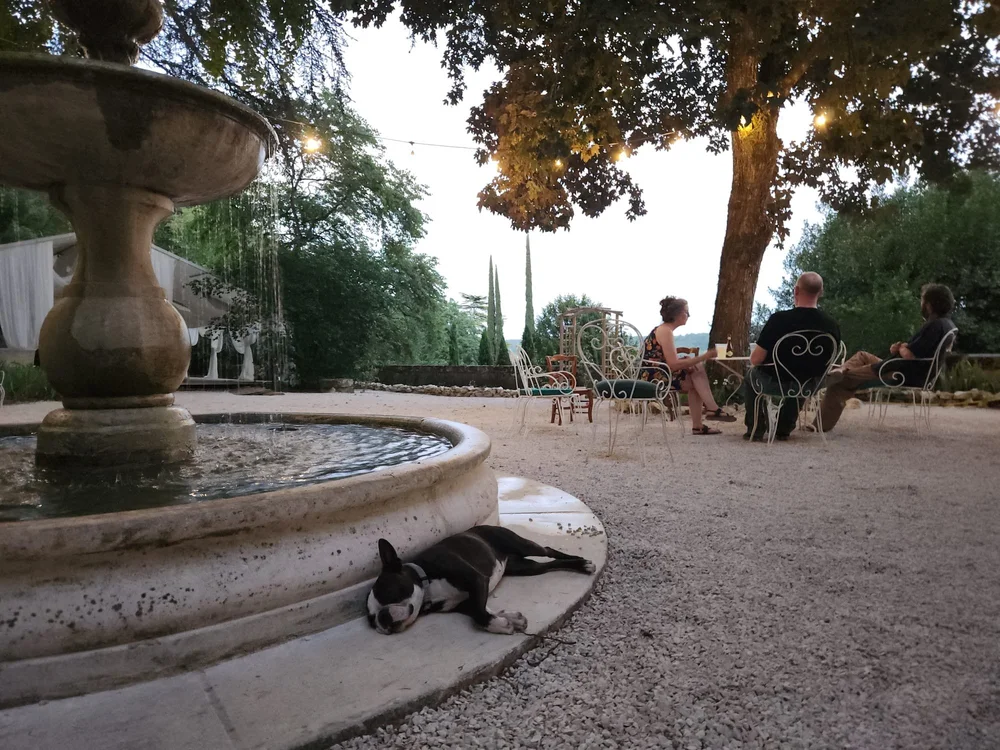
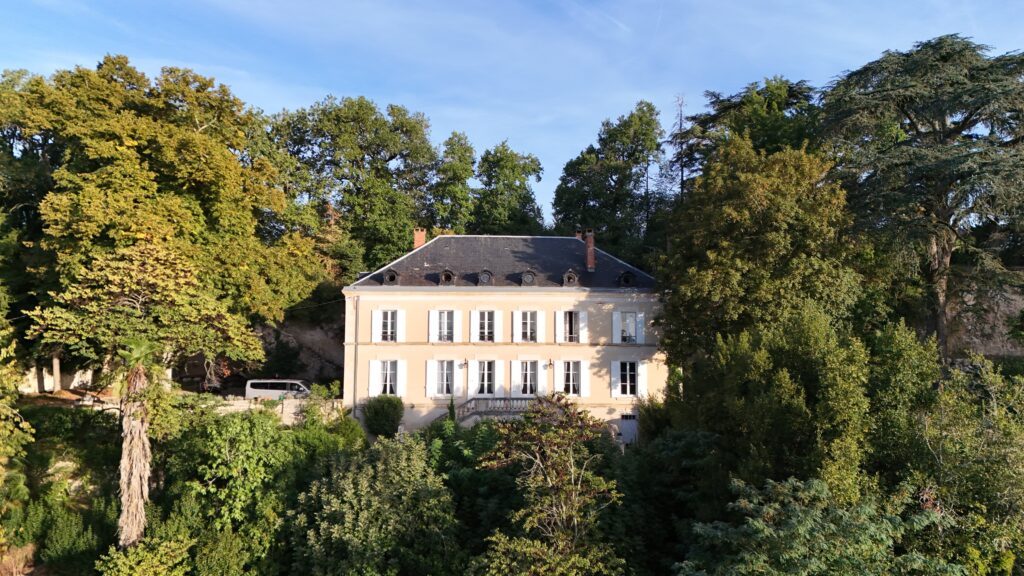
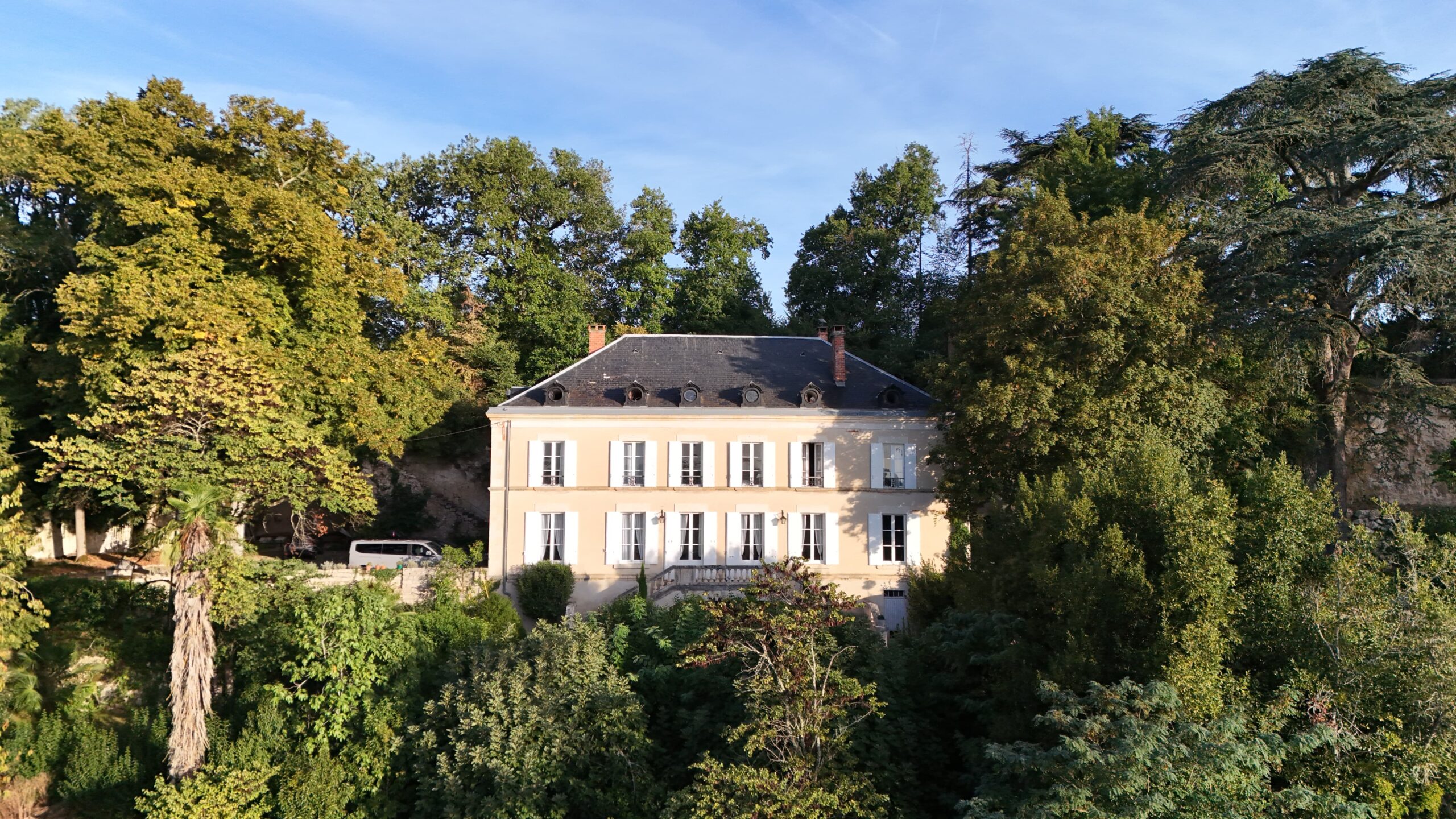
Château de Borie courtyard. Photo source: The Château Chronicles.
If you want a small-group week that makes French part of your experience of the place, see the current retreat details and availability. If you want a highly structured school timetable, use the questions above to compare the schools first.
What to do before and after your immersion week
Before: Choose three real-life situations, learn the phrases that let you begin and recover when you do not understand, and tell your teacher your level honestly. “I read quite well but freeze when someone replies” is much more useful than “I think I am intermediate.”
During: Collect short, reusable expressions. Try the same one in more than one place. Ask someone to slow down or repeat instead of ending the conversation. Notice when you understood more than you expected.
After: Put two or three of those situations into your calendar. Practise with a teacher, a local conversation partner or a friend. If you will soon move to France, make your next practice about your appointment, street, market or project. If you have no immediate French-speaking contact, the Feel Good French 50+ online course page explains one way to keep learning with support.
The trip is a beginning you can build on. The real test is whether you use one of your new sentences again when nobody has put “French immersion” on your schedule.
Frequently asked questions about learning French in France
Can a complete beginner do French immersion in France?
Yes, if the programme accepts beginners and gives you enough support to follow along. Ask whether your specific date has a beginner group, how instructions are explained and what language you will use at meals and outings. A highly intensive mixed-level programme may feel quite different from a beginner-friendly retreat.
How long should an adult French immersion stay be?
It depends on what you want to do. One week can help you practise a narrow set of situations and learn how you react in real conversations. Two or more weeks give you more opportunities to repeat and adjust. If you are comparing a one-week retreat with a two- or four-week school, compare the learning goals and total time commitment, not the word “immersion.”
Is countryside immersion better than learning French in a city?
The countryside can give you shared meals and repeated encounters if your programme creates them. A city gives you more independent choices and a wider range of courses. Neither setting makes you speak automatically. Ask what your ordinary afternoon and evening will look like, who you will meet, and how you will get around.
Which region is best for an adult learning French in France?
Start with the course and the kind of week you want, then choose between regions. Southwest France offers places such as Bordeaux, Toulouse and residential stays; the southeast includes Provence and the Riviera; the Loire Valley, Normandy, Auvergne and the Alps offer different rhythms. The local accent need not be a barrier to learning standard French. Your level, teaching fit and chances to practise matter more than a postcard-perfect address.
Is Villefranche-sur-Mer the best place for French immersion?
It is a strong candidate if you want the Institut de Français’s intensive two- to four-week format and can commit the time and budget. It is not automatically the best match for a one-week traveller, a beginner wanting a slower start or someone who wants a residential cultural retreat. Choose the programme before you fall for the postcard.
What is the difference between a French language school and a retreat?
A school usually centres on a timetable of level-based lessons. A retreat may include teaching, but it also gives substantial space to shared experiences, local culture and free time. Ask for the actual hours and activities. A retreat is not an exam-preparation course unless it explicitly says so.
Are French immersion programmes for over-50s taught only with older adults?
Not always. Some place 50+ participants together for language lessons; others mix adults by level in class and organise age-specific activities afterwards. Check the exact arrangement for your date.
What if I am placed in a class that is too easy or too difficult?
Ask how the placement test measures speaking as well as reading, listening and writing, and whether you can change groups after the first day. Your skills may be uneven: you might read a newspaper but struggle to answer a quick question at a café. Tell the school that before arrival. A learner describing a Montpellier course raised exactly this issue; their experience is a prompt to ask about the school’s current placement process, not proof of a problem in every class.
How much homework will I have during an intensive course?
It depends on the course and your level. Ask for a sample day including homework, not only the advertised lesson hours. A two-hour evening assignment feels very different after a full day of French than it does at home. If you also want time to explore, compare a morning-only course with an intensive one and ask whether extra workshops are optional.
Will I be lonely if I travel to French immersion on my own?
Many people travel alone, but the social structure varies. Ask whether your group meets outside lessons, whether outings are included, and whether meals are shared. A teacher homestay gives sustained contact with the host but may have no other students; a school may have plenty of classmates yet leave evenings to you. In a public discussion among older learners, one person preferred a group precisely because they wanted companions for cafés and exploring. Decide which company you would enjoy, then check the timetable.
Is a host family better than a hotel or apartment?
A host home can give you extra conversation, especially at meals, but it is not guaranteed all-day teaching. Check whether the host usually joins you for dinner, what language is spoken at home, the bathroom arrangement, house rules, and the journey to school. If you need a quiet evening, a kitchen or dietary flexibility, an apartment may suit you better. Ask for the specific lodging terms, not simply “homestay included.”
Can I join if I have dietary needs or limited mobility?
Often, but ask about your actual dates and accommodation before paying. A host may be able to adapt meals; an independent studio may make food easier to manage. For mobility, check stairs, bathroom access, the walk from your room to class, and the terrain and length of each excursion. An older learner comparing Montpellier options highlighted the distance between lodging and school; the issue is practical, not an age label. Ask what happens if you sit out a scheduled activity.
How do I avoid spending the week speaking English after class?
Before you book, look for planned French beyond lessons: guided market tasks, conversation over meals, a host who wants to talk, or classmates willing to meet in French. A learner considering a month-long course voiced the worry that evenings might slip back into English. You cannot control every conversation, and rest is allowed. You can choose one small daily task and ask your teacher to help you prepare and review it.
What should I check before paying a deposit?
Get the current written quote for your exact dates and level. It should separate teaching, registration, materials, room type, meals, outings and transfers; show the cancellation terms and any minimum group size; and say what happens if your level group does not run. Check travel insurance and any visa requirements that apply to you through official sources. A published “from” price is useful for a shortlist, but it is not a booking confirmation.
Will everyone speak French all day?
That varies widely. An intensive school can set French-only rules during teaching and meals, while evenings are yours. A homestay may offer long conversations with a host. A retreat may move between English explanations, supported French practice and informal social time. Ask which parts are genuinely conducted in French and whether that suits your level.
Do I need to be confident before I go?
No. You do need a setting where you can ask for help, try again and be understood at your level. If the first phrase disappears when someone answers, tell the organiser. That is useful information for choosing a programme, not a reason to stay home.
How can I tell whether a French immersion school is still operating?
Open the school’s own website and look for a current course page, calendar or booking path. Check that the specific programme still runs at your level and dates; a live homepage alone is not proof of availability. If a page only shows last year’s dates, ask for the new schedule before making travel plans.