French Civic Test 2026: 10 Practice Questions & Answers
French civic life starts with the places and symbols around you.
The French civic test, or examen civique, is a multiple-choice exam in French: 40 questions, up to 45 minutes, and 32 correct answers to pass. Since 1 January 2026, certain first residence-card applications and naturalisation by decree require it. Your application determines which version to take.
Quite happy discussing lunch in French, rather less happy explaining who votes a law? Fair enough. Lunch rarely comes with four possible answers.
Start with the rules below, or go straight to the free quiz. You get ten original practice questions, explained answers and optional English and pronunciation help.
Rules checked on 10 November 2026. Use the linked official guidance to check your own application.
40questions in French
45minutes maximum
32/40needed to pass · 80%
Who needs the French civic test in 2026?
Start with the name of your application. A visa, a residence card and French nationality are different procedures, even when the same folder follows you around the house.
Your application, where covered by the rules
Civic-exam version
Separate French level, where required
First multi-year residence card
CSP · carte de séjour pluriannuelle
A2
First resident card
CR · carte de résident
B1
Naturalisation or reintegration by decree
Naturalisation
B2
Already renewing a card?
Renewing a CSP or resident card does not require this exam. Applying for a first card of another type can be different.
Civic knowledge ≠ language level
Your DELF, TCF or TEF result does not by itself replace the civic-exam certificate. Check both requirements.
Exceptions depend on your route
Residence-card rules include an exemption for people over 65 and specific permit categories. Do not carry that age exemption over to naturalisation.
Disability or health conditions may justify adjustments or a documented exemption. Nationality by declaration, including through marriage, is outside this civic-exam requirement. Check the residence-card civic-exam guide or the naturalisation-by-decree guide for your route.
There are 28 knowledge questions and 12 scenario questions, with four choices and one correct answer per question. You take it digitally in an approved centre. The five themes are values of the Republic; institutions; rights and duties; history, geography and culture; and life in French society.
Marianne represents the French Republic. Her bust appears in town halls: a useful reminder that civic vocabulary belongs to places and symbols you encounter in France.
La République → lah ray-pew-bleek The Republic
Where are the official civic-test questions?
Use the list for your application. These are free official resources:
The knowledge questions are public; scenario questions remain confidential. Practice scenarios are training material, not a sneak preview of your session. The Ministry’s preparation portal also provides free revision resources. You do not need to buy access to the official lists.
French civic-test practice: try 10 questions
Choose one answer, check the explanation, then move on. Two questions cover each official theme. English and pronunciation help are optional: try the French first.
These are original teaching exercises, not an official paper or a full 40-question mock exam. Your score is a revision starting point, not a prediction of your exam result.
Your practice score
Ten teaching questions, not a prediction of your official result.
When you know the idea but the French gets in the way
First find who, what action, and which condition. A question about an employee at work is different from one about a person using the service. A question about what is allowed is different from one about what is compulsory. Very official nouns can be remarkably distracting.
Permission
Est-ce autorisé ?À l’oreille: ehs oh-toh-ree-zayIs it allowed?
Can the person do it?
Obligation
Cette personne doit respecter la règle.À l’oreille: seht pehr-sun dwah rehs-pek-tay lah rehglThis person must follow the rule.
Must the person do it?
My political-science background comes in handy here. Once you know what an institution does, the vocabulary has somewhere to live. It becomes more interesting than collecting official-looking nouns.
How to read the pronunciation cues
These are approximate listening and reading aids, not IPA. oo sounds like “food”; zh like the middle of “measure”; ew suggests French u, made by saying “ee” with rounded lips. ahn, ohn and ehn suggest nasal vowels, without a full English “n”.
Turn a wrong answer into useful revision
“I didn’t know that.”
Return to the official topic sheet. Explain the fact in your own words, then try a different example.
“I knew it in English.”
Keep the whole French sentence. Say it aloud and connect each useful expression to its meaning.
“I missed that detail.”
Find the person, age or condition you skipped. Read the question again before looking at the options.
Try 25 minutes: five reading one topic, eight answering questions, seven reviewing mistakes and five explaining one idea aloud. Later, add timed 40-question practice for your version. Your collection of 37 open quiz tabs can take the evening off.
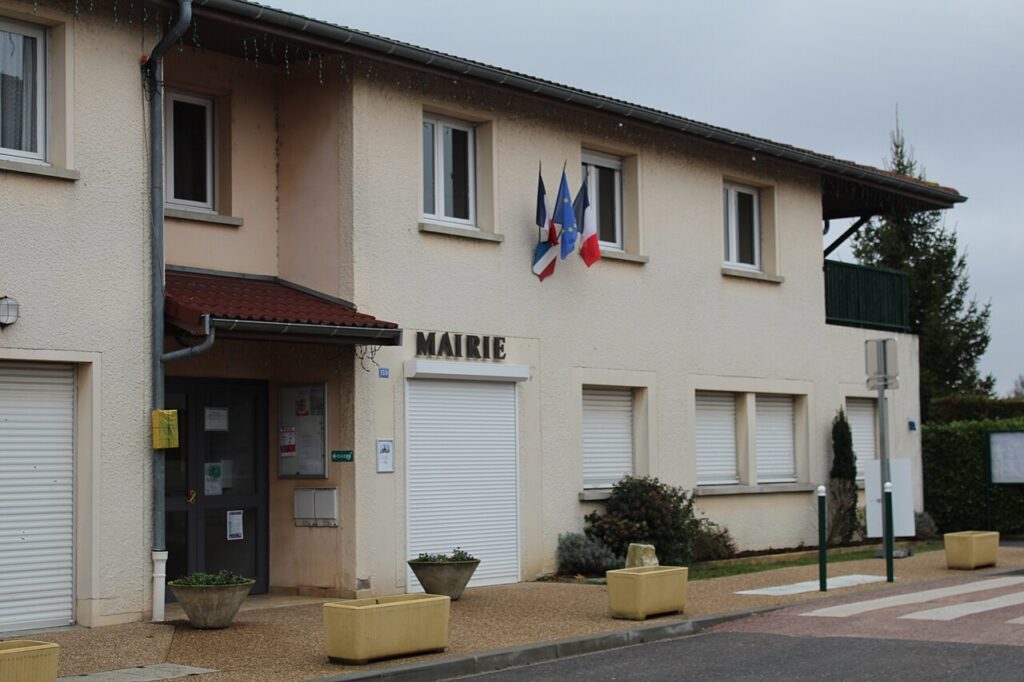
The town hall in Le Plantay.
Beyond the exam
The town hall is a real place, too
Who works here? Which document are you asking for? Connecting the topic to a practical situation helps you use the French afterwards.
No. The official questionnaire and answer choices are in French, as specified in the exam regulations. English explanations can help during preparation; practise recognising the French wording before test day.
How many answers do I need to pass?
At least 32 out of 40: 80%. You have up to 45 minutes. Our ten-question quiz is short practice, so its score does not establish whether you will pass the full exam.
Do I need it to renew my residence card?
Not for renewal of an existing multi-year residence card or resident card. A first application for a different card type may have different requirements. Check your exact procedure in the official residence-card guide.
Is there an exemption if I am over 65?
Service Public gives an over-65 exemption for the residence-card civic exam. Do not assume this applies to nationality by decree: the naturalisation rules have their own medical adjustments and exemption conditions.
Is this the same as my French language test or naturalisation interview?
No. The civic QCM tests civic knowledge in French. Language evidence is a separate requirement. The naturalisation interview is separate too: selecting an answer on screen and explaining an idea aloud need different practice.
How much does it cost, and where do I book?
Register with an approved centre and select your exam version. The centre sets the fee. The CCI describes €70 as a Ministry recommendation, not a compulsory national price; check the actual fee and available dates before paying. See the CCI registration guide and its exam FAQ. Optional preparation lessons cost separately.
Can I retake it, and does the certificate expire?
For residence cards, the Ministry says the successful-exam certificate has no expiry date and attempts are unlimited. Check the centre’s next session and fee after a failed attempt. Plan to have the certificate before submitting an application that requires it. See the Ministry’s guidance; for nationality, follow the naturalisation instructions.
Work on the bit that is actually difficult
You understand the answer in English. Let’s make the French click.
Bring one question that stopped you, the name of your application and your deadline. In my civic-exam preparation course, we work through the ideas, unpack the wording and practise explaining why an answer makes sense.
That gives us something useful to work on. “I should probably revise everything” is a rather less manageable lesson plan.