

Everyday French · The people next door
A neighbour has your parcel. You need to borrow a stepladder, or ask someone to water two pots while you are away. A few useful French phrases can open the conversation. The details make the arrangement work.
To ask a favour in French, Est-ce que je pourrais vous demander un service ? À l’oreille: ess kuh juh poo-reh voo duh-mahn-day uhn sair-veesmeans “Could I ask you a favour?” Follow it with the task, the day and what you are asking the person to agree to.
I’m Déborah, your Feel Good French teacher. Let’s make that request clear, then practise what happens when the answer is “yes, but Friday only”.
Start with a greeting, then ask a specific favour
For an ordinary practical favour, demander un service duh-mahn-day uhn sair-veesis a useful starting point. The Académie française’s entry for service includes this construction. You can name the task directly once you have greeted the person.
With a neighbour you address as vous voo, keep the same form in the request. With someone you already address as tu tew, use the familiar version. You do not have to change the relationship just because you need a favour.
Bonjour ! Est-ce que je pourrais vous demander un service ?À l’oreille: bon-zhoor ess kuh juh poo-reh voo duh-mahn-day uhn sair-vees
Hello! Could I ask you a favour?
Salut ! Est-ce que tu pourrais me rendre un service ?À l’oreille: sah-lew ess kuh tew poo-reh muh rahn-druh uhn sair-vees
Hi! Could you do me a favour?
Both are requests, rather than instructions. Vous pourriez… voo poo-ryaymeans “Could you…?” and je pourrais… juh poo-rehmeans “Could I…?” You can use them in a complete sentence without learning an entire conditional-tense table first.
A clear request gives the other person something they can answer
Say what you need and when. If you are asking for a visit while you are away, explain the actual task: two pots on the terrace, the post, or one agreed check. “Could you look after the house?” can mean quite different things to two people.
- What exactly would the person do?
- On which day or days?
- Would they need access, an object or instructions?
- What do you need to confirm after their answer?
Leave room for the answer to change your plan. A favour works better as an agreement than as a collection of hints the neighbour is expected to decode.
Useful French for favours, keys and parcels
Recall the French before opening each card. The reveal gives the word, approximate pronunciation, meaning and a sentence you can reuse. These cues are reading aids, not a phonetic alphabet.
Recall the FrenchA favour or some practical helpReveal word, sound and example ↓
un serviceÀ l’oreille: uhn sair-vees
A useful word for an ordinary favour.
Est-ce que je pourrais vous demander un service ?À l’oreille: ess kuh juh poo-reh voo duh-mahn-day uhn sair-vees
Could I ask you a favour?
Recall the FrenchA spare set of keysReveal word, sound and example ↓
un double des clésÀ l’oreille: uhn doobl day klay
A duplicate set, rather than the only keys you have.
Je vous laisse un double des clés.À l’oreille: juh voo less uhn doobl day klay
I will leave you a spare set of keys.
Recall the FrenchA parcelReveal word, sound and example ↓
un colisÀ l’oreille: uhn koh-lee
A parcel or package. The final s is silent.
Je passerai chercher le colis demain matin.À l’oreille: juh pah-suh-ray shair-shay luh koh-lee duh-man mah-tan
I will come to collect the parcel tomorrow morning.
Recall the FrenchTo water the plantsReveal word, sound and example ↓
arroser les plantesÀ l’oreille: ah-roh-zay lay plahnt
Say which plants and on which days.
Est-ce que vous pourriez arroser les deux pots vendredi ?À l’oreille: ess kuh voo poo-ryay ah-roh-zay lay duh poh vahn-druh-dee
Could you water the two pots on Friday?
Recall the FrenchTo borrow somethingReveal word, sound and example ↓
emprunterÀ l’oreille: ahm-pruhn-tay
The borrower receives something temporarily.
Est-ce que je pourrais vous emprunter votre escabeau ?À l’oreille: ess kuh juh poo-reh voo zahm-pruhn-tay votr es-kah-boh
Could I borrow your stepladder?
Recall the FrenchTo return a borrowed objectReveal word, sound and example ↓
rapporterÀ l’oreille: rah-por-tay
Bring the object back; add the agreed time.
Je vous le rapporte vendredi avant 17 heures.À l’oreille: juh voo luh rah-port vahn-druh-dee ah-vahn dees-set ur
I will bring it back to you on Friday before 17:00.
Ask a neighbour to water the plants or come round

Here is a fictional situation: you will be away for a week, and you would like two terrace pots watered on Tuesday and Friday. The request stays small and concrete.
Je pars une semaine. Est-ce que vous pourriez arroser les deux pots sur la terrasse mardi et vendredi ?À l’oreille: juh par ewn suh-men ess kuh voo poo-ryay ah-roh-zay lay duh poh sewr lah teh-rahs mar-dee ay vahn-druh-dee
I am going away for a week. Could you water the two pots on the terrace on Tuesday and Friday?
Je peux vous montrer avant de partir.À l’oreille: juh puh voo mon-tray ah-vahn duh par-teer
I can show you before I leave.
If you need someone to come round rather than do one named task, specify what the visit would involve. A word such as passer pah-saymeans come by or call in; it does not supply the instructions on its own.
Est-ce que vous pourriez passer à la maison vendredi pour vérifier que tout va bien ?À l’oreille: ess kuh voo poo-ryay pah-say ah lah may-zon vahn-druh-dee poor vay-ree-fee-ay kuh too vah byan
Could you come by the house on Friday to check that everything is all right?
Then agree what “everything is all right” means for this visit. If you need a photo, a message or a particular item checked, ask about that explicitly. Keep the agreed task separate from anything you decide to add later.
Agree how to hand over and get back the keys
Quand est-ce que je peux vous apporter les clés ?À l’oreille: kahn tess kuh juh puh voo zah-por-tay lay klay
When can I bring you the keys?
Je passerai les reprendre à mon retour.À l’oreille: juh pah-suh-ray lay ruh-prahn-dr ah mon ruh-toor
I will come and collect them when I get back.
Settle a time for that exchange too. “I will leave you the keys” is a plan to arrange, not proof the neighbour has received them.
Ask about a parcel, then arrange when to collect it
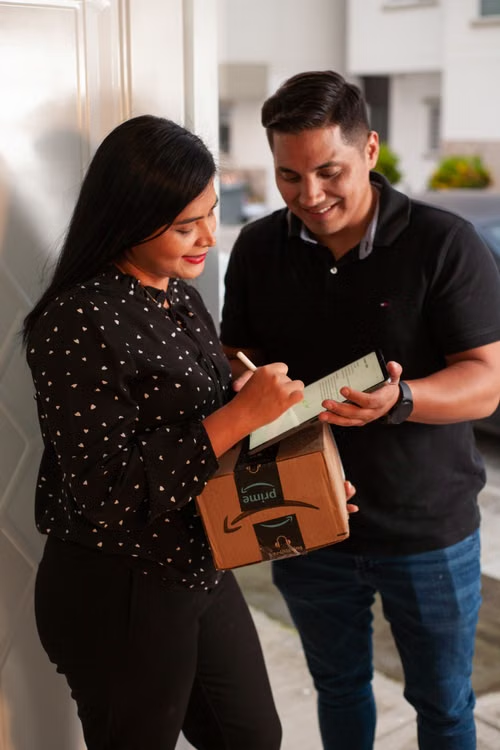
For a neighbour who may receive a delivery while you are out, make the request conditional. You are asking for help if the parcel reaches them, not appointing them to spend the day waiting by the door.
Si un colis arrive chez vous pour moi, est-ce que vous pourriez le garder jusqu’à ce soir ?À l’oreille: see uhn koh-lee ah-reev shay voo poor mwah ess kuh voo poo-ryay luh gar-day zhews-kah suh swahr
If a parcel for me arrives at your place, could you keep it until this evening?
Whether a delivery can be left with a neighbour depends on the actual delivery arrangements. Check those separately. In the conversation, make sure the person is willing and agree how you will collect it.
Merci ! À quelle heure est-ce que je peux passer le chercher ?À l’oreille: mair-see ah kel ur ess kuh juh puh pah-say luh shair-shay
Thank you! What time can I come to collect it?
Notice le chercher luh shair-shay: here, “collect it”. The parcel has already been named, so the short word le luhtakes its place. Listen for the same idea in a reply about a different day or time.
Borrow something, and say when you will return it
For a stepladder, a folding chair or a tool, keep the borrower and the lender clear. Emprunter means borrow; prêter means lend. The person doing the action changes between the two sentences below.
Est-ce que je pourrais vous emprunter votre escabeau jusqu’à vendredi ?À l’oreille: ess kuh juh poo-reh voo zahm-pruhn-tay votr es-kah-boh zhews-kah vahn-druh-dee
Could I borrow your stepladder until Friday?
Est-ce que vous pourriez me prêter votre escabeau jusqu’à vendredi ?À l’oreille: ess kuh voo poo-ryay muh preh-tay votr es-kah-boh zhews-kah vahn-druh-dee
Could you lend me your stepladder until Friday?
Both ask for the same loan. In the first, you borrow; in the second, the neighbour lends. A return time makes the request easier to judge, especially if they need the object themselves.
Je vous le rapporte vendredi avant 17 heures.À l’oreille: juh voo luh rah-port vahn-druh-dee ah-vahn dees-set ur
I will bring it back to you on Friday before 17:00.
For the keys, the model used les reprendre lay ruh-prahn-dr, collect them again. For the stepladder, le rapporter luh rah-por-taymeans bring it back. The pronoun and the direction both matter.
Understand the “yes, but…” and give a useful reply
Your neighbour can be happy to help and unavailable on one of the days. Listen for what follows mais meh, “but”, and repeat the part you have actually agreed.
A fictional exchange
Je peux passer vendredi, mais pas mardi.À l’oreille: juh puh pah-say vahn-druh-dee meh pah mar-dee
I can come round on Friday, but not Tuesday.
Merci pour vendredi. Je vais trouver une autre solution pour mardi.À l’oreille: mair-see poor vahn-druh-dee juh veh troo-vay ewn ohtr soh-lew-syon poor mar-dee
Thank you for Friday. I will find another solution for Tuesday.
This keeps the help that was offered and solves the remaining part separately. If the answer is no, you can close the request warmly:
Pas de souci, merci quand même.À l’oreille: pah duh soo-see mair-see kahn mem
No problem, thank you anyway.
Thank the person for the actual help
Merci encore pour votre aide. Ça me rend vraiment service.À l’oreille: mair-see ahn-kor poor votr ed sah muh rahn vreh-mahn sair-vees
Thank you again for your help. It really helps me out.
You can offer to help another time without turning the exchange into a debt. Let the relationship find its own rhythm. Some neighbours become close friends; others remain friendly people with whom you make clear, occasional arrangements.
Practice: what has actually been agreed?
These fictional situations use the details that matter in real exchanges. All the options try to continue the conversation; choose the one that respects the information. You can reveal translation and pronunciation help, check the feedback and retry.
Write a request that your neighbour can answer
You will be away for a week. Ask a neighbour you address as vous to water the two terrace pots on Tuesday and Friday. Offer to show them what to do, and ask when you could bring the keys. Use a short message with a greeting and a thank-you.
Your writing stays in this page. It is not sent or assessed automatically.
Compare with one possible request
Bonjour ! Je pars une semaine. Est-ce que vous pourriez arroser les deux pots sur la terrasse mardi et vendredi ? Je peux vous montrer avant de partir. Quand est-ce que je peux vous apporter les clés ? Merci beaucoup !À l’oreille: bon-zhoor juh par ewn suh-men ess kuh voo poo-ryay ah-roh-zay lay duh poh sewr lah teh-rahs mar-dee ay vahn-druh-dee juh puh voo mon-tray ah-vahn duh par-teer kahn tess kuh juh puh voo zah-por-tay lay klay mair-see boh-koo
Hello! I am going away for a week. Could you water the two pots on the terrace on Tuesday and Friday? I can show you before I leave. When can I bring you the keys? Thank you very much!
- Can the neighbour identify the task and the two days?
- Have you asked, rather than written as if they have already agreed?
- Do all the pronouns match the register you chose?
- Is the key handover still a question to confirm?
Now change the plan: the neighbour can help on Friday only. Write a two-sentence reply accepting Friday and saying what you will do about Tuesday. Several natural replies are possible. Compare the meaning with the model in the “yes, but…” section, not just the individual words.
For another writing task, try the French email lesson on openings, endings and clear arrangements.
Your questions
Asking a favour in French
How do I say “Can I ask you a favour?” in French?
A useful polite version is Est-ce que je pourrais vous demander un service ?ess kuh juh poo-reh voo duh-mahn-day uhn sair-vees With someone you already address as tu, you can say Est-ce que je pourrais te demander un service ?ess kuh juh poo-reh tuh duh-mahn-day uhn sair-vees Follow it with the specific request. The opening model above includes pronunciation.
Should I say service or faveur?
For everyday practical help from a neighbour, demander un service is a natural starting point. Faveur also exists in French, so it is not simply a wrong word. The models here use service for concrete tasks such as watering plants or keeping a parcel.
Should I use tu or vous with French neighbours?
Follow the form you already use with that person. A favour is not a reason to switch suddenly. If you have not established tu, vous gives you a polite starting point; you can adapt the models as your relationship develops.
What if my neighbour can only help on one day?
Confirm that day and arrange the remaining task separately. The answer “Friday, but not Tuesday” is agreement to Friday only. Practise the whole reply rather than remembering only the initial yes.
How do I say I will return something I borrowed?
For the stepladder in this article, “Je vous le rapporte vendredi avant 17 heures” means “I will bring it back to you on Friday before 17:00.” Change the object’s pronoun and the return details to match your actual arrangement.