
Asking questions in French can feel tricky, especially because there are several different ways to ask them. French has a whole set of question words (où, comment, pourquoi, qui, etc.) and different ways to structure a question depending on the situation.
We’ll go through the most common French question words and explain the three main ways to ask a question: using intonation, est-ce que, and inversion. You’ll also learn the difference between est-ce que and qu’est-ce que: a common source of confusion!
At the end, you’ll find two exercises to help you practice — one on question words and another on forming questions with est-ce que and qu’est-ce que.
- How to Use Common French Question Words Correctly
- 3 Ways to Ask Questions in French
- Est-ce que vs Qu’est-ce que
- When to Use Each Type of Question
- Common Mistakes with French Question Words
- Exercise 1: Complete the Questions with the Correct Question Word
- Exercise 2: Complete the Questions with Est-ce que or Qu’est-ce que
- Want to Improve Your French Grammar?
- French Question Words Worksheet
- French Question Words: Common Questions
- More French Grammar Guides
- Build the Life You’ve Dreamed of in France.
How to Use Common French Question Words Correctly
French question words are essential for asking about information, not just yes/no questions. Here are the most important ones:
| French Question Word | Meaning | Example |
|---|---|---|
| Où | Where | Où est la boulangerie ? (Where is the bakery?) |
| Quand | When | Quand arrives-tu ? (When are you arriving?) |
| Comment | How | Comment vas-tu ? (How are you?) |
| Pourquoi | Why | Pourquoi tu fais ça ? (Why are you doing that?) |
| Qui | Who | Qui est là ? (Who is there?) |
| Que/Quoi | What | Que fais-tu ? (What are you doing?) |
| Combien (de) | How much/many | Combien ça coûte ? (How much does it cost?) |
French speakers naturally adjust the question structure depending on the formality and context.
3 Ways to Ask Questions in French
There are three main ways to structure a question in French. The key is knowing when to use each one.
1. Intonation – Casual and conversational
The easiest way to ask a question is to raise your voice at the end of a statement. This works well in informal situations with friends and family.
- Tu viens ce soir ? (Are you coming tonight?)
- Il est là ? (Is he here?)
✅ Best for: Friends, family, and informal conversations
2. Est-ce que – Clear and polite
Est-ce que introduces a yes/no question and makes it 100% clear that you’re asking a question. It’s very helpful for beginners because it gives a clear structure to the question.
- Est-ce que tu viens ce soir ? (Are you coming tonight?)
- Est-ce que vous savez où est la gare ? (Do you know where the train station is?)
You can also use est-ce que with question words:
- Où est-ce que tu vas ? (Where are you going?)
- Comment est-ce que tu fais ça ? (How do you do that?)
✅ Best for: Polite/formal situations, or when you’re unsure which structure to use
3. Inversion – Formal or polished
Inversion is more formal and common in written French or when you want to sound polished. It involves swapping the subject and the verb.
- Viens-tu ce soir ? (Are you coming tonight?)
- Savez-vous où est la gare ? (Do you know where the train station is?)
If the subject is a noun, you need to restate the subject:
- Où Marie va-t-elle ? (Where is Marie going?)
✅ Best for: Formal speech or writing
Est-ce que vs Qu’est-ce que
This is a common point of confusion!
Est-ce que = introduces a yes/no question
- Est-ce que tu aimes le vin ? (Do you like wine?)
- Est-ce que vous venez ce soir ? (Are you coming tonight?)
Qu’est-ce que = introduces a “what” question (direct object)
- Qu’est-ce que tu fais ? (What are you doing?)
- Qu’est-ce que tu manges ? (What are you eating?)
💡 Think of qu’est-ce que as replacing “what” in an English question.
When to Use Each Type of Question
| Situation | Example | Recommended Structure |
|---|---|---|
| Casual conversation with friends or family | Tu viens ce soir ? | Intonation |
| Polite/formal situation (e.g., asking a stranger) | Est-ce que vous savez où est la gare ? | Est-ce que |
| Writing or formal speech | Savez-vous où est la gare ? | Inversion |
| Emphasis or insistence | Est-ce que tu viens vraiment ce soir ? | Est-ce que |
Common Mistakes with French Question Words
- Mixing up “est-ce que” and question words
- ❌ Où est-ce que la boulangerie ?
- ✅ Où est la boulangerie ?
- Forgetting the inversion rule
- ❌ Où Marie va ?
- ✅ Où va Marie ?
- Using “qu’est-ce que” instead of “est-ce que“
- ❌ Qu’est-ce que tu parles anglais ?
- ✅ Est-ce que tu parles anglais ?
Exercise 1: Complete the Questions with the Correct Question Word
Complete the questions with the correct French question word (quand, que, combien, qui, où, comment, pourquoi):
- __________ est la boulangerie ?
- __________ tu t’appelles ?
- __________ tu fais ça ?
- __________ il arrive ?
- __________ est là ?
- __________ vous partez en vacances ?
- __________ tu veux manger ce soir ?
- __________ il parle si vite ?
- __________ coûte ce pull ?
- __________ est ton acteur préféré ?
Exercise 2: Complete the Questions with Est-ce que or Qu’est-ce que
Use est-ce que or qu’est-ce que to form the following questions:
- __________ tu parles anglais ?
- __________ vous avez vu ce film ?
- __________ tu sais où est la pharmacie ?
- __________ vous pouvez m’aider ?
- __________ tu fais ?
- __________ il mange ?
- __________ tu veux faire aujourd’hui ?
- __________ tu as besoin ?
- __________ tu comprends ?
- __________ c’est ?
Want to Improve Your French Grammar?
If you’d like to take your French grammar to the next level, check out my article Bon, Bien, Meilleur, Mieux Explained (Exercises Included) — it’s packed with practical tips and examples to help you sound more natural in French!
French Question Words Worksheet
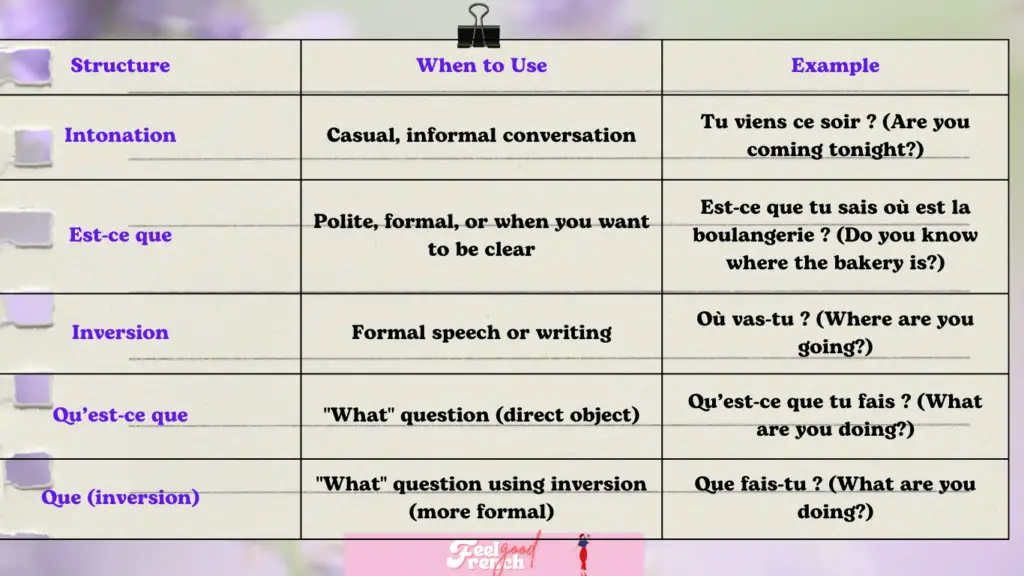
Here’s a quick summary of today’s lesson. Hopefully, the visuals will make it easier to remember!
Build the Life You’ve Dreamed of in France.
Join Survive & Thrive in France – my signature programme combining practical French, cultural confidence, and a welcoming community to help you truly feel at home in France.
French Question Words: Common Questions
Keep your question structure simple, and your French questions will start sounding much more natural.
More French Grammar Guides
French Bakery Phrases for Ordering Bread Without Freezing

French Pharmacy Phrases for Real Life in France

French Delivery Phrases for Life in France

French Appointment Phrases for Life in France
French Phone Call Phrases for Life in France