

You are at a market in Provence, ordering a coffee in Nice, or trying to follow a quick conversation at the bakery and suddenly a tiny French verb seems to carry the whole sentence.
For many English-speaking expats and future expats, that is the moment French verb conjugation starts to feel bigger than it really is.
The reassuring part is this: a huge part of everyday spoken French follows simple patterns. Regular -ER verbs like parler (par-lay), aimer (eh-may), chercher (sher-shay), demander (duh-mon-day), or commander (ko-mon-day) appear everywhere in daily life in France, from cafés and markets to appointments and small conversations with neighbours.
Once you start recognising those patterns, French stops sounding chaotic. You do not need to memorise endless conjugation tables before you can understand more and speak with confidence.
- What Are Regular French -ER Verbs?
- Why regular -ER verbs matter more than you think
- The pronouns you will hear in real French
- Remove the -ER and listen for the pattern
- 20 Common French -ER Verbs Used in Daily Life
- How to practise without turning this into homework
- FAQ About French -ER Verb Conjugation
- More Articles About French Grammar
- Build the Life You’ve Dreamed of in France.
What Are Regular French -ER Verbs?
French has irregular verbs. They matter. Être, avoir, and aller are common, and they do not politely follow the tidy rules.
Yet this lesson is not where you need to fight every irregular verb at once.
The useful first idea is that many French verbs belong to the regular -ER family. Parler, chercher, habiter, and aimer all share a family resemblance. Once you recognise the stem and the endings, you begin to see the same shape again and again.
That is why French verb conjugation can become a listening tool, not just a grammar exercise. You start hearing the pattern in real sentences — at the bakery, in a hotel, with a neighbour, or when someone asks if you are looking for something.
Why regular -ER verbs matter more than you think
Regular -ER verbs are not a tiny corner of French. They are the everyday workhorses.
The lesson phrase says it clearly: Plus de 80% des verbes français suivent un modèle simple. More than 80% of French verbs follow a simple pattern.
That does not mean French suddenly becomes effortless. It means your brain has something reliable to hold onto.
Instead of seeing each new verb as a separate problem, you can begin asking a aother question: does this verb behave like the ones I already know? Very often, especially at beginner level, the answer is yes.
This is particularly useful if you are learning French after 50, or after moving to France, or while preparing for the practical reality of living here. You are not learning grammar for a test on paper. You are learning enough structure to keep a conversation going.
Build the Life You’ve Dreamed of in France.
Join Survive & Thrive in France – my signature programme combining practical French, cultural confidence, and a welcoming community to help you truly feel at home in France.
The pronouns you will hear in real French
Before the verb changes, you need to know who is doing the action.
The pronouns in this lesson are the ones you will meet constantly: je, tu, vous, on, and nous.
Vous deserves special attention. It is the safe, polite form when you are speaking to a shopkeeper, a pharmacist, a waiter, a new neighbour, or anyone you do not know well. If you are unsure whether to use tu or vous, vous is usually the respectful choice.
On is just as important for listening. In written French, you may learn nous for “we”. In spoken French, people often use on. When someone says on habite en France, they mean “we live in France”. When they say on visite les marchés, they mean “we are visiting the markets”.
These small pronoun choices are not decorative grammar. They change what you understand in real life.
Remove the -ER and listen for the pattern
Take chercher, which means “to look for”. Remove the -er, and you have the stem: cherch-.
| Pronoun | Regular -ER example | Everyday meaning |
|---|---|---|
| je | je cherche | I am looking for |
| vous | vous cherchez | you are looking for |
| on | on cherche | we / people are looking for |
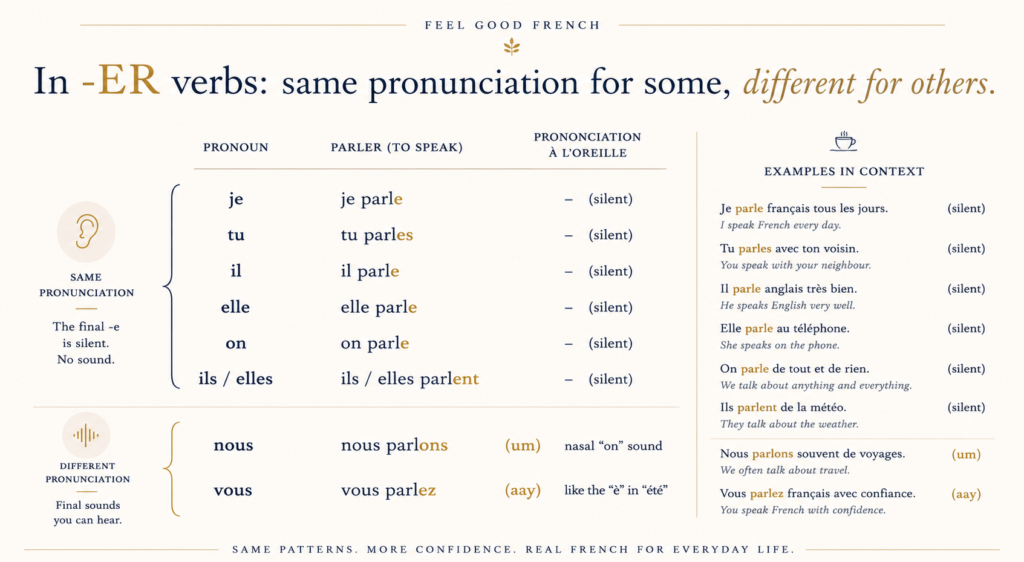
Then the endings do their work.
The interesting part is that several forms sound the same. Je cherche, tu cherches, il cherche, and ils cherchent are written differently, but in everyday speech they are almost identical.
Real conversation is not a spelling test.
That sentence matters. If you are trying to hear every written ending in spoken French, you may think you are failing. Often, there is simply nothing extra to hear. Your job is to catch the stem, the pronoun, and the situation.
That is why this pattern is kind to your brain. It reduces the noise. If you need to double-check the conjugaison, I recommend a website that conjugate all verbs, in all tenses such as this one.
20 Common French -ER Verbs Used in Daily Life
Notice how practical these are. None of them belongs only in a classroom. You can imagine them in a café, at a market, during a village visit, or in the tiny conversation that makes France feel a little more open.
Je parle un peu français.
juh parl un puh fron-say
I speak a little French.
Vous parlez anglais ?
voo parl-ay on-glay
Do you speak English?
Vous cherchez quelque chose ?
voo shair-shay kelk shohz
Are you looking for something?
On habite en France.
on ah-beet on fronss
We live in France.
On adore l’architecture française.
on ah-dor lar-shee-tek-tuur fron-sayz
We love French architecture.
Vous aimez ce marché ?
voo zay-may suh mar-shay
Do you like this market?
| Verb | Pronunciation | Meaning |
|---|---|---|
| parler | parl-ay | to speak |
| aimer | ay-may | to like / to love |
| chercher | shair-shay | to look for |
| habiter | ah-bee-tay | to live |
| manger | mon-jay | to eat |
| regarder | ruh-gar-day | to watch / to look at |
| écouter | ay-kou-tay | to listen |
| acheter | ash-tay | to buy |
| travailler | trah-vah-yay | to work |
| demander | duh-mon-day | to ask |
| donner | doh-nay | to give |
| penser | pon-say | to think |
| arriver | ah-ree-vay | to arrive |
| rester | ress-tay | to stay |
| visiter | vee-zee-tay | to visit |
| cuisiner | kwee-zee-nay | to cook |
| voyager | vwah-yah-jay | to travel |
| étudier | ay-tu-dee-yay | to study |
| rencontrer | ron-kon-tray | to meet |
| marcher | mar-shay | to walk |
How to practise without turning this into homework
Choose three regular -ER verbs you actually need.
Not twenty. Three.
For example: parler, chercher, and aimer. Say them with je, vous, and on. Those three pronouns already cover a lot of real life: what you do, what someone else politely does, and what “we” do in spoken French.
You might practise:
- Je parle un peu français.
- Vous cherchez quelque chose ?
- On aime ce marché.
Then listen for the same shapes around you. The bakery queue, the pharmacy, a French film, a neighbour in the stairwell — these are not formal lessons, but they are exactly where the pattern becomes familiar.
You do not have to conquer French verb conjugation all at once.
Start by recognising the family resemblance. Let your ear meet the same pattern several times. Let the spelling become a support, not a burden.
Petit à petit, French verbs stop looking like a wall. They start looking like doors.
FAQ About French -ER Verb Conjugation
Petit à petit, French starts to feel good.
More Articles About French Grammar

French Bakery Phrases for Ordering Bread Without Freezing

French Pharmacy Phrases for Real Life in France

French Delivery Phrases for Life in France

French Appointment Phrases for Life in France

French Phone Call Phrases for Life in France