
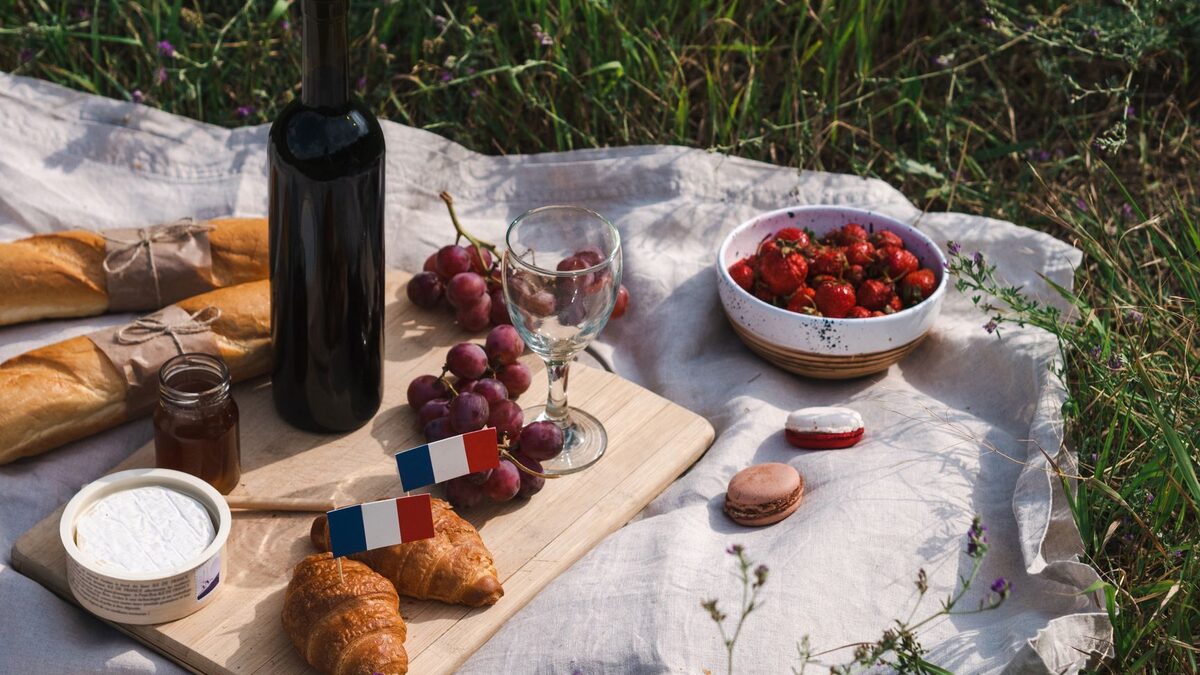
You arrive at a picnic in France with a baguette under your arm, a wedge of cheese from the market, or a little box of strawberries you chose carefully because you wanted to bring something.
Then the social part begins.
Someone opens a bottle. Someone passes bread. Someone offers you a slice of tart. The conversation moves between food, weather, weekend plans, and small jokes you almost catch.
This is where many English-speaking expats and future expats feel the quiet panic. You may know the French words for cheese, bread, wine, and picnic. Yet you may not know what to say when someone offers you food, when you want to ask for the knife, or when you simply want to sound warm rather than frozen.
You do not need perfect French for a picnic in France.
You need a few phrases that fit the moment.
- French Picnic Phrases For Invitations And Gentle Suggestions
- At the Picnic: Sharing Food and Being Polite
- Simple Phrases for Taste, Preferences, and Allergies
- Small Talk That Keeps the Moment Going
- Cultural Notes: How French Picnics Feel Social, Not Formal
- A Gentle Practice Plan Before Your Next Picnic
- Frequently Asked Questions
- More From Feel Good French
- Build the Life You’ve Dreamed of in France.
French Picnic Phrases For Invitations And Gentle Suggestions
Picnics in France often sit somewhere between a meal and an apéro. They can be casual, shared, and pleasantly improvised: a blanket, market food, bread, cheese, fruit, something to drink, and a few people arriving with whatever made sense that morning.
If you are inviting someone, keep it simple.
On fait un pique-nique ce week-end ? Shall we have a picnic this weekend?
Ça te dit de faire un pique-nique ? Would you like to have a picnic?
On pourrait apporter chacun quelque chose. We could each bring something.
Je peux apporter du fromage et du pain. I can bring cheese and bread.
For beginners, Ça te dit ? is especially useful. It literally means something like “Does that say to you?” but in real life it means “Do you feel like it?” or “Would you be up for it?”
That one phrase can carry a lot of social softness. It is less formal than a grand invitation and more natural for everyday plans.
If you are not sure what to bring, ask directly:
Qu’est-ce que je peux apporter ? What can I bring?
Tu veux que j’apporte quelque chose ? Do you want me to bring something?
This is not just vocabulary. It is a small social code. Offering to bring something shows you understand the shared nature of the moment.
Build the Life You’ve Dreamed of in France.
Join Survive & Thrive in France – my signature programme combining practical French, cultural confidence, and a welcoming community to help you truly feel at home in France.
At the Picnic: Sharing Food and Being Polite
Once everyone is sitting down, the most useful French is often not impressive. It is practical, kind, and well timed.
When someone offers you food, you can say:
Oui, volontiers. Yes, gladly.
Avec plaisir. With pleasure.
Merci, c’est gentil. Thank you, that’s kind.
If you want only a little:
Juste un petit morceau, merci. Just a small piece, thank you.
Un tout petit peu, s’il te plaît. Just a tiny bit, please.
And if you are passing food around:
Tu en veux ? Would you like some?
Vous en voulez ? Would you like some? (polite or plural)
Servez-vous. Help yourself.
Je t’en prie. Go ahead / you’re welcome.
Notice the little word en in Tu en veux ? It means “some of it.” You do not need to analyze it deeply at the picnic. Just learn the phrase as a whole. Real conversation is not a grammar exam.
If you need something, you can ask without fuss:
Tu peux me passer le pain ? Can you pass me the bread?
Vous pouvez me passer le couteau, s’il vous plaît ? Could you pass me the knife, please?
Il y a des serviettes ? Are there napkins?
These are the phrases that make you feel included because they let you participate in the small choreography of the meal.
Simple Phrases for Taste, Preferences, and Allergies
Food reactions matter in France, but they do not need to become a performance.
If you like something, say it simply:
C’est très bon. It’s very good.
C’est délicieux. It’s delicious.
J’aime beaucoup. I like it a lot.
C’est frais. It’s fresh.
Ça vient du marché ? Is it from the market?
That last question is useful because it opens conversation. French picnics often include small stories about where something came from: the bakery, the market, a neighbor’s garden, a favorite cheese shop.
If you do not want something, keep it gentle:
Non merci, pas pour moi. No thank you, not for me.
Je vais en reprendre plus tard. I’ll have some more later.
Je n’ai plus très faim, merci. I’m not very hungry anymore, thank you.
For allergies or dietary needs, clarity is more important than elegance:
Je suis allergique aux noix. I’m allergic to nuts.
Je ne mange pas de viande. I don’t eat meat.
Il y a du gluten dedans ? Is there gluten in it?
Je dois faire attention au lactose. I have to be careful with lactose.
You do not need to apologize for having a real need. A calm sentence is enough.
Small Talk That Keeps the Moment Going
The fear at a picnic is often not the first sentence. It is the second one.
You can say Bonjour, accept a slice of quiche, and then suddenly feel the conversation sliding away from you.
Prepare a few small-talk bridges. They do not need to be clever.
Vous habitez dans le coin ? Do you live nearby?
Vous venez souvent ici ? Do you come here often?
Il fait beau aujourd’hui. The weather is nice today.
C’est un endroit très agréable. This is a very pleasant place.
Vous connaissez un bon marché dans le quartier ? Do you know a good market in the neighborhood?
Vous êtes ici depuis longtemps ? Have you been here long?
For expats, one of the most useful sentences is also one of the most honest:
Je suis encore en train d’apprendre le français. I’m still learning French.
That word encore matters. It means “still” or “yet,” and it gives your learning a sense of movement. You are not failing at French. You are in the middle of it.
If someone speaks too fast, try:
Vous pouvez répéter, s’il vous plaît ? Can you repeat, please?
Un peu plus lentement, s’il vous plaît. A little more slowly, please.
Most people are more patient when they understand what you need.
Cultural Notes: How French Picnics Feel Social, Not Formal
A French picnic is usually relaxed, but relaxed does not mean careless.
There is often a quiet rhythm: greet everyone, offer what you brought, accept food politely, avoid taking the last piece without checking, and show appreciation for what others contributed.
You may hear:
Tu veux goûter ? Do you want to taste it?
C’est fait maison. It’s homemade.
Ça vient du marché. It’s from the market.
On partage ? Shall we share?
The mood is social, not formal. People may talk over each other a little. Food may move around without a strict order. Someone may refill glasses before you realize yours is empty.
Your job is not to perform perfect Frenchness.
Your job is to join the rhythm in small ways: offer, thank, taste, ask, smile, and use one sentence when the moment opens.
That is how French becomes part of daily life. Not as a list you memorized alone, but as a few words that help you stay present with other people.
A Gentle Practice Plan Before Your Next Picnic
Do not try to learn every phrase in this article before your next picnic.
Choose five.
Choose one phrase for inviting:
Ça te dit de faire un pique-nique ?
Choose one phrase for bringing something:
Qu’est-ce que je peux apporter ?
Choose one phrase for accepting:
Oui, volontiers.
Choose one phrase for asking:
Tu peux me passer le pain ?
Choose one phrase for staying in the conversation:
Je suis encore en train d’apprendre le français.
Say them out loud three times. Picture the real moment: the blanket, the bread, the person offering you something, the small pause before you answer.
This kind of practice works because your brain remembers language better when it is attached to a scene. You are not just learning words. You are rehearsing belonging.
Next time you are invited to a picnic, use one phrase.
One is enough to begin.
If you want help building the kind of French that works in real daily life — at the market, with neighbors, during apéro, and in small social moments — Feel Good French is built for exactly that. Keep going gently.
Petit à petit, French starts to feel good.
Frequently Asked Questions
More From Feel Good French

Learning French in the Age of AI

Is 50 Too Late to Learn French? The Honest Answer
How long does it realistically take to learn French?
French Picnic Phrases for Beginners

What Is the 80 20 Rule for Learning French?
