
If you live in France, even with basic French, you hear être and avoir everywhere. At the bakery, at the doctor’s office, at the mairie, with neighbors, or during everyday conversations. These two verbs are unavoidable. And as a French teacher, I can tell you this: beginner learners struggle with them all the time.
I see it constantly in class. Students at A1 or A2 level who are motivated and making progress suddenly hesitate when they have to choose between être or avoir. The reason is simple. These verbs are extremely common, but they are also irregular and used very differently from English. Very often, English uses to be where French uses avoir, especially when talking about age, feelings, or physical states. That’s exactly where confusion starts.
The good news is that once you understand when to use être and when to use avoir, a huge part of French suddenly becomes clearer. Sentences start to make sense. Conversations feel smoother. And you stop translating word for word.
In this article, you will:
- understand the real meaning of être and avoir in everyday French
- recognize the most common situations where beginner learners make mistakes
- practice with real-life examples from expat life in France
- build confidence through simple, practical exercises
This is not about memorizing rules. It’s about learning how French actually works in real situations.
- What does avoir mean in French?
- Learn French With an Experienced Language Coach
- What does être mean in French?
- Être and avoir: present tense verb charts
- Être and Avoir mp3 recording to practice the pronunciation
- The most common mistake (and how to fix it)
- Être or Avoir? Exercises With Real-Life Situations
- French vocabulary recap
What does avoir mean in French?
Avoir is not used the same way in French
Avoir means to have, but in French it’s also used to talk about:
- age
- physical states
- feelings
- needs
This is very different from English.
Avoir in everyday expat life
- J’ai une maison en France → jé une mè-zon an frans → I have a house in France
- J’ai 68 ans → jé swa-sant-uit an → I am 68 years old (not je suis)
- J’ai faim → jé fain → I’m hungry
- J’ai besoin d’un médecin → jé be-zwan dun mèd-sin → I need a doctor
In all these cases, French uses avoir, even though English uses to be.
What does être mean in French?
Être is the French verb for “to be”, and it’s one of the most common verbs in the language. You use it to talk about who you are, where you are, and your general situation in life — which is why you hear it constantly in everyday conversations in France.
When to use être in French
Être means to be, and it’s used for:
- identity
- nationality
- profession
- location
- general state
Être in everyday expat life
- Je suis américain → je sui za-mé-ri-kin → I am American
- Nous sommes à Aix-en-Provence → nou som z-a èks an pro-vans → We are in Aix-en-Provence
- Je suis à la retraite → je sui a la rè-trèt → I am retired
- Ils sont contents d’être ici →il son kon-tan dèt-r i-si → They are happy to be here
Être and avoir: present tense verb charts
These two verbs are irregular, so it’s important to recognize their forms.
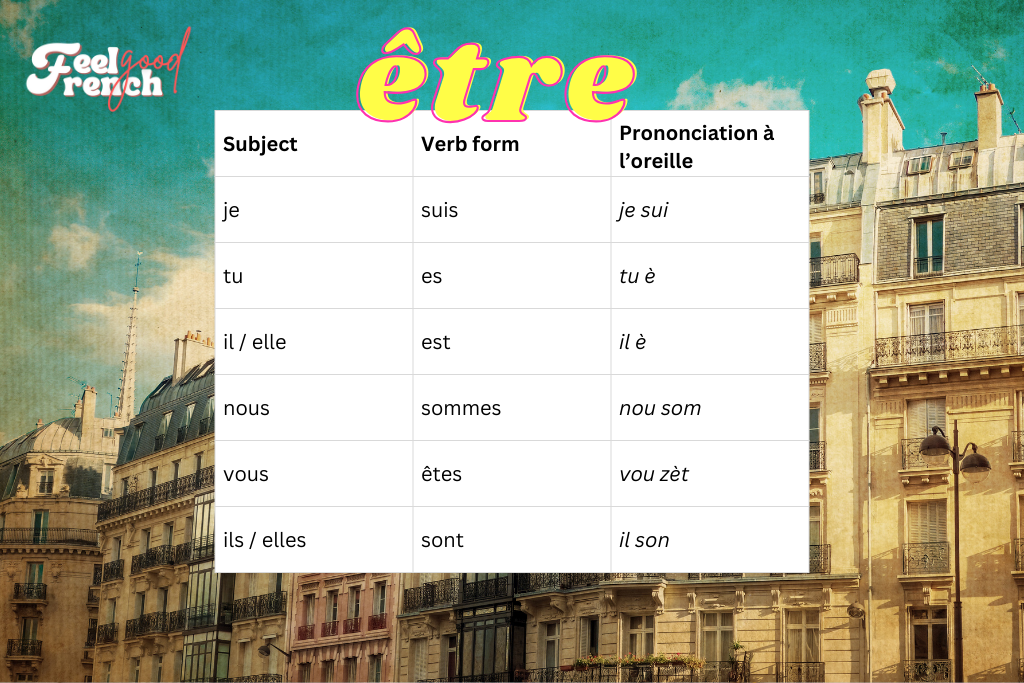
Être – present tense
- je suis – je sui
- tu es – tu è
- il / elle est – il è
- nous sommes – nou som
- vous êtes – vou zèt
- ils / elles sont – il son
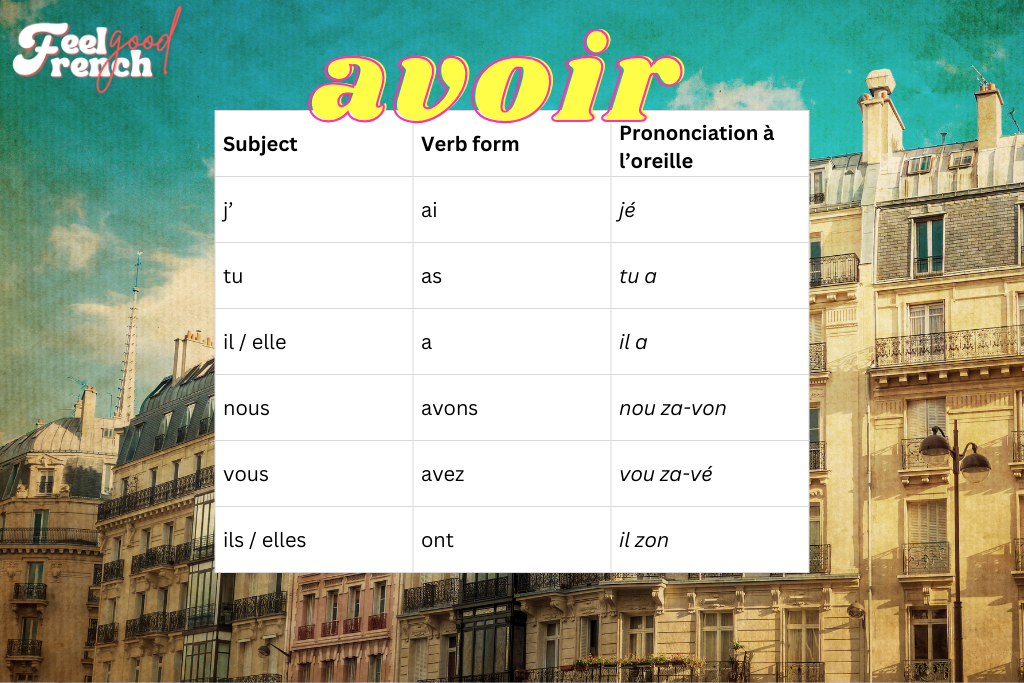
Avoir – present tense
- j’ai – jé
- tu as – tu a
- il / elle a – il a
- nous avons – nou za-von
- vous avez – vou za-vé
- ils / elles ont – il zon
Être and Avoir mp3 recording to practice the pronunciation
Feel free to read aloud after me. Be playful and speak loud!
The most common mistake (and how to fix it)
English speakers often translate directly.
❌ Je suis 65 ans
✅ J’ai 65 ans
❌ Je suis faim
✅ J’ai faim
❌ J’ai américain
✅ Je suis américain
If you remember only one thing:
👉 Age, hunger, fear, and needs use avoir, not être.
Être or Avoir? Exercises With Real-Life Situations
Choose the correct verb (être or avoir).
- Je ___ retraité depuis trois ans.
- Nous ___ une petite maison près du village.
- Tu ___ faim après le marché ?
- Ils ___ très contents de vivre ici.
- Vous ___ français ou américains ?
Fill in with the correct form of être or avoir.
- J’___ besoin d’aide pour les papiers.
- Nous ___ à la mairie ce matin.
- Elle ___ peur de parler français.
- Vous ___ à la retraite maintenant ?
- Ils ___ une vie très agréable ici.
Choose the correct French sentence
- a) Je suis 70 ans b) J’ai 70 ans
- a) J’ai content b) Je suis content
- a) Nous sommes une maison ici b) Nous avons une maison ici
Read each situation and choose the sentence that you would actually say in France.
- Talking about your age at the doctor’s office: a) Je suis 72 ans b) J’ai 72 ans
- Explaining how you feel after a long day: a) J’ai fatigué b) Je suis fatigué
- Talking about your situation in France: a) Nous sommes une maison ici b) Nous avons une maison ici
- At the bakery, early in the morning: a) Je suis faim b) J’ai faim
- Introducing yourself to a neighbor: a) Je suis américain b) J’ai américain
Être or Avoir: take the interactive quiz below.
Bravo! You are done! If you want to go further and practice “regular verbs” in the present like “aimer”, check this post.
French vocabulary recap
| French word | Meaning | Prononciation à l’oreille |
|---|---|---|
| être | to be | è-tr |
| avoir | to have | a-vwar |
| j’ai | I have | jé |
| je suis | I am | je sui |
| j’ai faim | I’m hungry | jé fain |
| j’ai besoin | I need | jé be-zwan |
| je suis à la retraite | I’m retired | je sui a la rè-trèt |
Sign Up for the Feel Good French Newsletter

When to Use Être or Avoir in French: Exercises With Real-Life Examples
If you live in France, even with basic French, you hear être and avoir everywhere….

Aimer in French: Meaning, Conjugation & Usage
Aimer in French looks simple. And in many ways, it is. It’s one of the…

Why “-ent” Is Silent in French Verbs (and Why That Matters)
If you’re an expat learning French, you’ve probably seen verbs ending in -ent and wondered…

How to Say “To Go” in French | Aller Verb Conjugation
The verb aller (to go) is one of the most essential and frequently used verbs…

French Sentences: Why You’re Getting Adjective Order Wrong (And How to Fix It)
Learning to place adjectives correctly in French sentences can be one of the most confusing…

Think You Know French Prepositions? À, En, Au, and Aux Might Surprise You!
“Je vais à Nice, en France, au marché… et aux urgences?” French prepositions of place…