
France has long been called le pays de l’amour (the country of love, luh pay-ee duh lah-moor), and for many Americans and francophiles, Valentine’s Day in France feels like the ultimate romantic fantasy. Paris, candlelight dinners, handwritten notes, quiet glances exchanged over a glass of wine. Tchin tchin mon amour! But beyond the clichés, what does Valentine’s Day really look like in France, and what do French people actually say on la Saint-Valentin?

From Bonne Saint-Valentin (Happy Valentine’s Day, bon sahn va-lon-tan) to everyday French terms of endearment, Valentine’s Day in French is less about grand declarations and more about nuance, rhythm, and understatement. If you’re an expat, a traveler, or simply someone who loves France and wants to connect more deeply with the culture, la Saint-Valentin is a perfect opportunity to learn real French expressions of love, understand French romantic culture, and move beyond textbook translations.
Here, we’ll explore how to say Valentine’s Day in French, what French people actually mean when they speak about love, and why learning French through culture and emotion is often the most natural way to sound authentic.
- Valentine’s Day in France: What Is It Called and When Is It Celebrated?
- Valentine’s Day in French: How Do You Say “Valentine”?
- How to Say “Happy Valentine’s Day” in French (and When to Use It)
- Learn French With an Experienced Language Coach
- French Words of Love You’ll Actually Hear on Valentine’s Day
- Valentine’s Day in France and the Influence of Cinema
- Why French Sounds So Melodic When Expressing Emotions
- Do French People Really Celebrate Valentine’s Day in France?
- Learning French Through Valentine’s Day: A Teacher’s Perspective
- French Valentine’s Day Vocabulary You’ll Actually Use
Valentine’s Day in France: What Is It Called and When Is It Celebrated?
Valentine’s Day in France is called la Saint-Valentin (Valentine’s Day, lah sahn va-lon-tan). It takes place on le quatorze février (February 14th, luh kah-torhz fay-vree-ay), just like in the United States.
But culturally, la Saint-Valentin is framed very differently. It is traditionally about couples only. There is no French equivalent of Galentine’s Day, no cards exchanged between friends, and no cheerful Valentine wishes sent to colleagues. Love, in French culture, tends to remain privé (private, pree-vay), almost protected.
This idea of intimacy over spectacle runs deep. French love is something lived quietly, not displayed. It is shared, not performed.
Valentine’s Day in French: How Do You Say “Valentine”?
A very common beginner question is how to say “Valentine” in French.
In French, the word exists:
- un Valentin (a male Valentine, uhn va-lon-tan)
- une Valentine (a female Valentine, oon va-lon-teen)

But here is where real usage matters.
French people rarely say mon Valentin or ma Valentine. While grammatically correct, it sounds old-fashioned, slightly theatrical, and disconnected from everyday speech. In real French, love is not labelled. It is implied, suggested, embodied.
This difference alone explains why many English speakers feel something is “missing” when they translate directly. French does not lack romance. It expresses it differently.
How to Say “Happy Valentine’s Day” in French (and When to Use It)
The correct and natural expression is:
Bonne Saint-Valentin (Happy Valentine’s Day, bon sahn va-lon-tan)
You might write it in a message or say it quietly to your partner. But many French couples don’t even say it out loud. Instead, they share un moment à deux (a moment for two, uhn moh-mon ah duh), a dinner, a walk, a pause.
In French culture, emotion often passes through le geste (the gesture, luh jest) rather than through words. Saying less is not cold. It is intentional.
French Words of Love You’ll Actually Hear on Valentine’s Day
Instead of “my Valentine”, French lovers use simple, everyday terms of affection that feel natural and deeply emotional.
You will hear:
- mon amour (my love, mon ah-moor)
- mon chéri / ma chérie (my dear, mon shay-ree / mah shay-ree)
- mon cœur (my heart, mon kur)
- mon trésor (my treasure, mon tray-zor)
These words are not reserved for Valentine’s Day. They belong to daily life. They are whispered in the kitchen, said on the phone, written in short text messages. Their power comes from repetition, not rarity.
If you’re curious about more playful or unexpected ways of expressing love, I explore this in another article on the blog where I explain the quirky ways to say “I love you” in French, expressions that often surprise learners because they sound simple but carry strong emotional weight.
Valentine’s Day in France and the Influence of Cinema
Our collective idea of French love owes a lot to cinema.
Many people associate French romance with Le Fabuleux Destin d’Amélie Poulain, where love is expressed through small acts, attention to detail, and la délicatesse (delicacy, lah day-lee-kah-tess). Romance is suggested, never shouted.

This sensibility comes partly from the Nouvelle Vague cinema of the 1960s, where lovers talk endlessly, smoke in bed, and let silence carry meaning. Love is shown as intellectual, sensual, imperfect, and deeply human.
Figures like Brigitte Bardot embodied a vision of l’amour nonchalant (effortless love, lah-moor nohn-sha-lon), a love rooted in freedom, desire, and presence rather than obligation or performance.
This cultural heritage still shapes how French people imagine and live romance today.
Why French Sounds So Melodic When Expressing Emotions
French is often described as a romantic language not because of exaggerated vocabulary, but because of its rhythm. Words flow into each other. Consonants soften. Stress disappears.
When a French person says je t’aime (I love you, zhuh tem), it is often said quietly, almost on one breath. And very often, we don’t say it at all.
We say:
- Je suis bien avec toi (I feel good with you, zhuh swee byen ah-vek twa)
- J’aime être avec toi (I like being with you, jem etr ah-vek twa)
- Tu me manques (I miss you, too muh monk)
These phrases are emotionally strong in French. They are subtle, but deeply embodied.
This approach echoes ideas explored by Roland Barthes in Fragments d’un discours amoureux, where love appears in fragments, hesitations, and inner movements rather than clear declarations.
Do French People Really Celebrate Valentine’s Day in France?
To answer short, yes, but quietly.
Valentine’s Day in France usually means un dîner en amoureux (a romantic dinner, uhn dee-nay ah-nuh-moor-uh), not public displays or extravagant gifts. It’s about time, attention, and being fully present.
This restraint often surprises American expats. But once understood, it reveals a culture where love is something you cultivate daily, not something you stage once a year.
Sign Up for the Feel Good French Newsletter
Learning French Through Valentine’s Day: A Teacher’s Perspective
As a French teacher, I truly believe that learning French through moments like Valentine’s Day is one of the most powerful ways to connect with the language. You don’t just learn vocabulary. You learn le ton (the tone), le rythme (the rhythm), and l’intention (the intention).
French is not about saying more.
It’s about saying just enough.
And that, perhaps, is the most French love lesson of all.
French Valentine’s Day Vocabulary You’ll Actually Use
To finish, here is a practical selection of French vocabulary for Valentine’s Day, with real-life meanings and prononciation à l’oreille. These are words and expressions you will genuinely hear in France, not poetic inventions reserved for greeting cards.
Valentine’s Day Vocabulary in French
| French word or expression | Meaning in English | Pronunciation (approx.) | When French people use it |
|---|---|---|---|
| la Saint-Valentin | Valentine’s Day | lah sahn va-lon-tan | The holiday itself |
| Bonne Saint-Valentin | Happy Valentine’s Day | bon sahn va-lon-tan | Said or written to a partner |
| un couple | a couple | uhn koop-l | Neutral, everyday word |
| être en couple | to be in a relationship | etr ahn koop-l | Very common |
| un amoureux / une amoureuse | a lover | uhn ah-moo-ruh / oon ah-moo-ruh-z | Slightly romantic, still natural |
| mon amour | my love | mon ah-moor | Very common, daily use |
| mon chéri / ma chérie | my dear | mon shay-ree / mah shay-ree | Warm, affectionate |
| mon cœur | my heart | mon kur | Intimate, tender |
| un dîner en amoureux | a romantic dinner | uhn dee-nay ah-nuh-moor-uh | Typical Valentine’s phrase |
| un moment à deux | time for the two of us | uhn moh-mon ah duh | Very French mindset |
| un petit geste | a small gesture | uhn puh-tee jest | More important than words |
| je pense à toi | I’m thinking of you | zhuh pons ah twa | Emotionally strong in French |
| tu me manques | I miss you | too muh monk | Said often, very sincere |
| je suis bien avec toi | I feel good with you | zhuh swee byen ah-vek twa | Very French way to express love |
For more real-life, film-inspired ways to express affection in French, you can also read this other article I wrote.
If you look closely, Valentine’s Day in France is not about finding the perfect words. It’s about choosing the right moment. Le bon moment. Un bon dîner, a shared smile. A simple sentence said without trying too hard. French doesn’t seduce by excess. It seduces by restraint.
So if you’re learning French, don’t chase grand declarations. Learn how to say less, but say it well. A je pense à toi. A tu me manques. A mon amour said naturally, without translating in your head. That’s where real French lives. And that’s often where love does too. Oh la la!
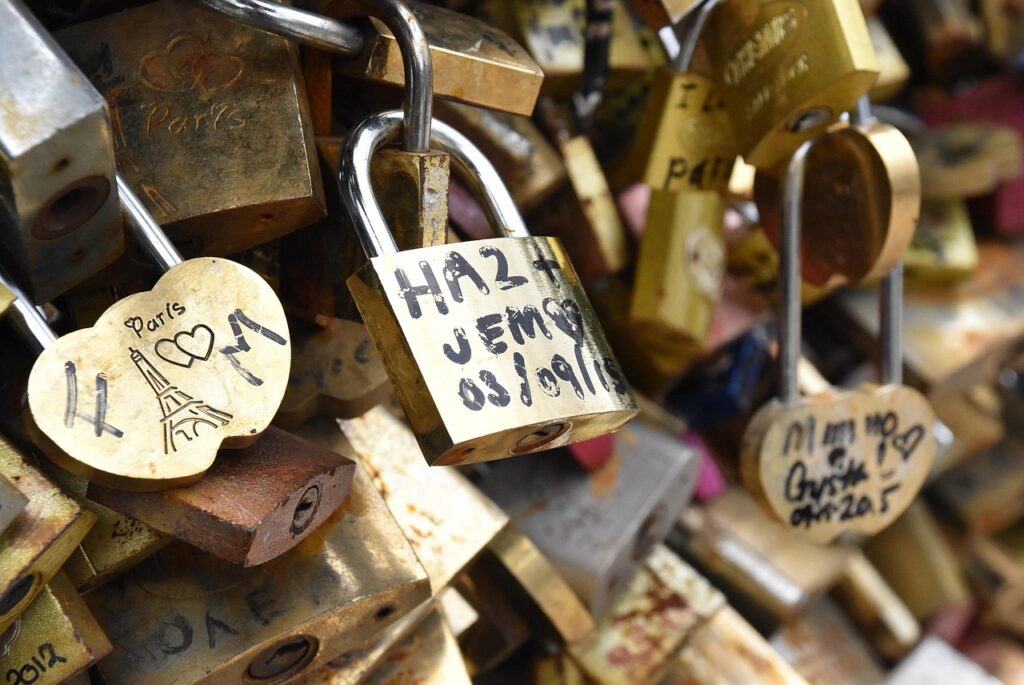
Valentine’s Day in France: How to Say It, Wish It, and Understand It in Real French
France has long been called le pays de l’amour (the country of love, luh pay-ee…

Go to the Bank in France: The American Expat’s Guide to French Banking
Moving to France as an American means discovering new food, new culture, and—yes—new bureaucracy. One…

French Clothing Sizes in US: A Clear Guide for American Expats
Your first weeks in France are a string of small delights and quick puzzles. The…
How to Practice Speaking French in Nice (Beginner Friendly)
You finally made it. You moved to Nice, one of the most beautiful cities on…

Why “-ent” Is Silent in French Verbs (and Why That Matters)
If you’re an expat learning French, you’ve probably seen verbs ending in -ent and wondered…

Bonjour Bonsoir Meaning in French: Greeting Rules You Must Know
When you’re learning French, one of the first things you’ll come across is the importance…