
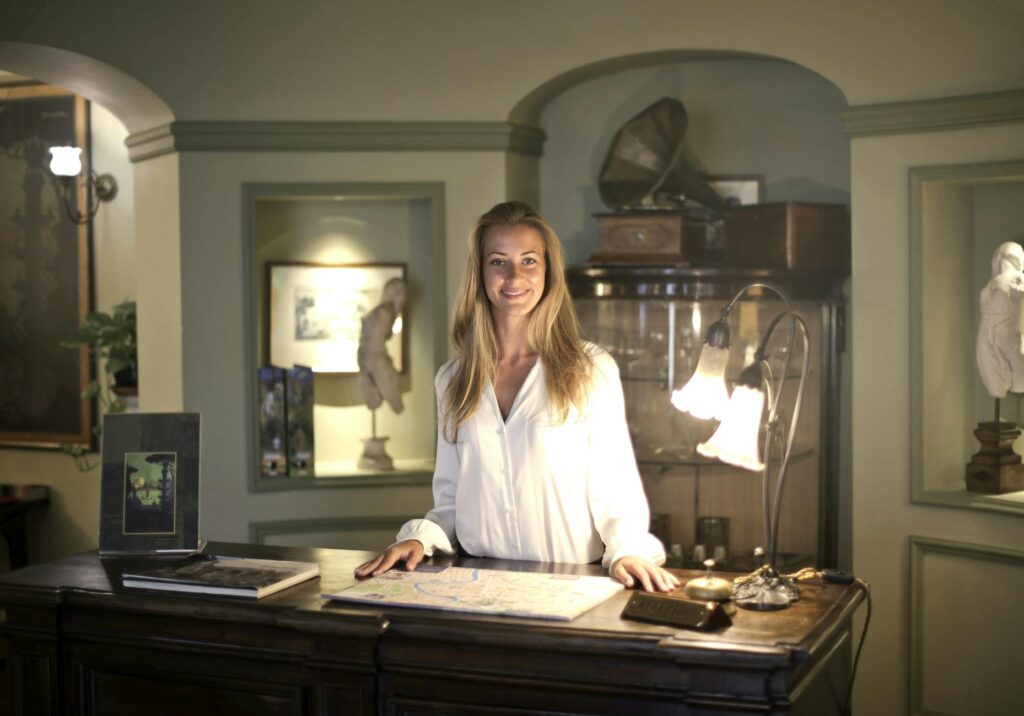

Reception work moves fast: visitors arrive, phones ring, appointments change and people need clear answers. The goal is not to speak perfect French; it is to sound calm, polite and useful in the moments that repeat every day.
Use this guide as a practical phrase bank for hotels, schools, clinics and offices. Each section gives you receptionist French you can practise immediately.
If your role also includes restaurant service, practise our French phrases for waiters, with customer replies, pronunciation and a short order-taking exercise.
- Greet visitors with confidence
- Manage appointments and arrivals
- Answer and transfer phone calls
- Give directions inside the building
- Stay polite in difficult moments
- Receptionist French: six quick practice questions
- Practise with the audio glossary
- French for Receptionists: Practical Questions
- Use French at the front desk
- More Professional French Guides
Welcome
Use a polite opening, then find out what the visitor needs.
Listen for the detail
Names, times and the person being called do different jobs.
Give the next step
Say where to wait, who you will contact or what you need to check.
How to read the à l’oreille cues
These are approximate aids for English speakers, not IPA. oo sounds like “food”; zh like the middle of “measure”; ew suggests French u, made by saying “ee” with rounded lips. ahn, ohn and ehn suggest nasal vowels without a full English “n”; ny suggests the soft sound in “onion”. Replace bracketed business names before rehearsing.
Greet visitors with confidence
A receptionist often creates the first impression. Use short, warm phrases that welcome the person, check what they need and keep the interaction moving.
Bonjour, est-ce que je peux vous aider ?
Bienvenue à [nom de l’entreprise] !
Avez-vous un rendez-vous ?
Je vous en prie, asseyez-vous.
Un instant s’il vous plaît.
English & pronunciation for these phrases
Bonjour, est-ce que je peux vous aider ?
À l’oreille: bon-zhoor, ehs-kuh juh puh voo-zay-day
Hello, can I help you?
Bienvenue à [nom de l’entreprise] !
À l’oreille: byehn-vuh-new ah [company name]
Welcome to [company name]!
Avez-vous un rendez-vous ?
À l’oreille: ah-vay voo-zehn rahn-day-voo
Do you have an appointment?
Je vous en prie, asseyez-vous.
À l’oreille: juh voo-zahn pree, ah-say-yay voo
Please, have a seat.
Un instant s’il vous plaît.
À l’oreille: ehn-nehn-stahn, seel voo pleh
One moment, please.
At the desk: check the visitor’s name
Visitor: Bonjour, j’ai rendez-vous avec Madame Martin.
You: Puis-je avoir votre nom, s’il vous plaît ?
English & pronunciation for this exchange
Visitor:
Bonjour, j’ai rendez-vous avec Madame Martin.
À l’oreille: bon-zhoor, zhay rahn-day-voo ah-vek mah-dam mar-tehn
Hello, I have an appointment with Ms Martin.
You:
Puis-je avoir votre nom, s’il vous plaît ?
À l’oreille: pweezh ah-vwahr voh-truh nohn, seel voo pleh
May I have your name, please?
Manage appointments and arrivals
Front-desk French needs precise questions about names, times and appointments. These phrases help you confirm details without sounding abrupt.
Vous avez rendez-vous avec qui ?
Puis-je avoir votre nom, s’il vous plaît ?
Votre rendez-vous est à quelle heure ?
Je vais prévenir Madame Martin.
La personne arrive dans quelques minutes.
English & pronunciation for these phrases
Vous avez rendez-vous avec qui ?
À l’oreille: voo-zah-vay rahn-day-voo ah-vek kee
Who is your appointment with?
Puis-je avoir votre nom, s’il vous plaît ?
À l’oreille: pweezh ah-vwahr voh-truh nohn, seel voo pleh
May I have your name, please?
Votre rendez-vous est à quelle heure ?
À l’oreille: voh-truh rahn-day-voo eh-tah kehl uhr
What time is your appointment?
Je vais prévenir Madame Martin.
À l’oreille: juh veh pray-vuh-neer mah-dam mar-tehn
I will let Ms Martin know.
La personne arrive dans quelques minutes.
À l’oreille: lah pehr-sun ah-reev dahn kehlk mee-newt
The person will arrive in a few minutes.
An appointment: listen for the time
You: Votre rendez-vous est à quelle heure ?
Visitor: J’ai rendez-vous à quinze heures.
You: Je vais prévenir Madame Martin.
English & pronunciation for this exchange
You:
Votre rendez-vous est à quelle heure ?
À l’oreille: voh-truh rahn-day-voo eh-tah kehl uhr
What time is your appointment?
Visitor:
J’ai rendez-vous à quinze heures.
À l’oreille: zhay rahn-day-voo ah kehn-zuhr
I have an appointment at 3 p.m.
You:
Je vais prévenir Madame Martin.
À l’oreille: juh veh pray-vuh-neer mah-dam mar-tehn
I will let Ms Martin know.
Answer and transfer phone calls
Phone French can feel harder because you cannot rely on gestures. Keep the structure predictable: greet, identify, clarify, transfer or take a message.
Bonjour, [nom de l’entreprise], que puis-je faire pour vous ?
Qui est à l’appareil ?
Ne quittez pas, je vous la passe.
La ligne est occupée.
Voulez-vous laisser un message ?
English & pronunciation for these phrases
Bonjour, [nom de l’entreprise], que puis-je faire pour vous ?
À l’oreille: bon-zhoor, [company name], kuh pweezh fehr poor voo
Hello, [company name], how can I help you?
Qui est à l’appareil ?
À l’oreille: kee eh-tah lah-pah-rehy
Who is calling?
Ne quittez pas, je vous la passe.
À l’oreille: nuh kee-tay pah, juh voo lah pahss
Hold on, I’ll put you through to her.
La ligne est occupée.
À l’oreille: lah leeny eh-toh-kew-pay
The line is busy.
Voulez-vous laisser un message ?
À l’oreille: voo-lay voo lay-say ehn meh-sazh
Would you like to leave a message?
On the phone: offer a next step
Caller: Je voudrais parler à Madame Martin, s’il vous plaît.
You: La ligne est occupée.
You: Voulez-vous laisser un message ?
English & pronunciation for this exchange
Caller:
Je voudrais parler à Madame Martin, s’il vous plaît.
À l’oreille: juh voo-dreh par-lay ah mah-dam mar-tehn, seel voo pleh
I would like to speak to Ms Martin, please.
You:
La ligne est occupée.
À l’oreille: lah leeny eh-toh-kew-pay
The line is busy.
You:
Voulez-vous laisser un message ?
À l’oreille: voo-lay voo lay-say ehn meh-sazh
Would you like to leave a message?
Give directions inside the building
Visitors often need the same practical instructions: where to wait, where to go and whom to meet. Simple direction phrases prevent confusion.
La salle d’attente est à droite.
Prenez l’ascenseur jusqu’au deuxième étage.
Le bureau est au bout du couloir.
Les toilettes sont à gauche.
Je vais vous accompagner.
English & pronunciation for these phrases
La salle d’attente est à droite.
À l’oreille: lah sahl dahn-tahnt eh-tah drwaht
The waiting room is on the right.
Prenez l’ascenseur jusqu’au deuxième étage.
À l’oreille: pruh-nay lah-sahn-suhr zhews-koh duh-zyehm ay-tazh
Take the lift/elevator to the second floor.
Le bureau est au bout du couloir.
À l’oreille: luh bew-roh eh-toh boo dew koo-lwahr
The office is at the end of the corridor.
Les toilettes sont à gauche.
À l’oreille: lay twah-leht sohn-tah gohsh
The toilets/restrooms are on the left.
Je vais vous accompagner.
À l’oreille: juh veh voo-zah-kohn-pah-nyay
I’ll show you the way.
A direction the visitor can use
Visitor: Où est la salle d’attente, s’il vous plaît ?
You: La salle d’attente est à droite.
English & pronunciation for this exchange
Visitor:
Où est la salle d’attente, s’il vous plaît ?
À l’oreille: oo eh lah sahl dahn-tahnt, seel voo pleh
Where is the waiting room, please?
You:
La salle d’attente est à droite.
À l’oreille: lah sahl dahn-tahnt eh-tah drwaht
The waiting room is on the right.
Stay polite in difficult moments
Receptionists sometimes handle late arrivals, complaints or stressed visitors. French politeness formulas help you stay calm and professional.
Je comprends.
Je vais vérifier.
Je suis désolé(e) pour l’attente.
Nous allons trouver une solution.
Je vais appeler mon responsable.
English & pronunciation for these phrases
Je comprends.
À l’oreille: juh kohn-prahn
I understand.
Je vais vérifier.
À l’oreille: juh veh vay-ree-fyay
I will check.
Je suis désolé(e) pour l’attente.
À l’oreille: juh swee day-zoh-lay poor lah-tahnt
I’m sorry for the wait.
Nous allons trouver une solution.
À l’oreille: noo-zah-lohn troo-vay ewn soh-lew-syohn
We will find a solution.
Je vais appeler mon responsable.
À l’oreille: juh veh ah-puh-lay mohn rehs-pohn-sahbl
I will call my manager.
Receptionist French: six quick practice questions
Choose the response or detail that fits the situation. Check the explanation, then move on. The English help is there if you need it; try reading the French first.
Your practice score
Your turn: welcome a visitor and check the appointment
A visitor has an appointment with Madame Martin. Ask politely for their name and appointment time. Say your questions aloud, then write them here if that helps.
Compare with one possible answer
Puis-je avoir votre nom, s’il vous plaît ?
À l’oreille: pweezh ah-vwahr voh-truh nohn, seel voo pleh
May I have your name, please?
Votre rendez-vous est à quelle heure ?
À l’oreille: voh-truh rahn-day-voo eh-tah kehl uhr
What time is your appointment?
Other natural, polite questions can work. Now change the person, time or department and practise the reply too.
Use fictional details. This practice text is not submitted or automatically graded.
Practise with the audio glossary
The original article includes an audio glossary. Use it actively: listen, repeat, pause and practise the phrases as if a real visitor were in front of you.
- Listen once for rhythm before reading the text.
- Repeat the phrases aloud slowly, then at natural speed.
- Practise names, times and departments with different examples.
- Record yourself and check whether the polite endings are clear.
Listen and repeat the receptionist phrases
Keep the original audio glossary with the article and use it as pronunciation practice. Repeat each phrase until the polite rhythm feels natural.
Reception French becomes easier when the phrases are short, polite and automatic.
French for Receptionists: Practical Questions
Start with the welcome, then master the handoff: greeting, checking, transferring, guiding and reassuring.
Use French at the front desk
Working in a hotel, guesthouse or tourism role? Our French for Hospitality & Tourism lessons help you practise reservations, guest questions and the follow-up conversation, with feedback at your level.
Bring a situation from your work, with names and confidential details removed. We can practise the reply that arrives after your perfectly prepared opening line.
More Professional French Guides
Restaurant service
Take an order, hear the change and check one detail →
The written follow-up
Arrange meetings, request documents and answer replies →
Professional vocabulary
Put workplace words into useful sentences →
Dealing with French Tradespeople: Quotes, Costs and Follow-ups
Is HomeExchange Worth It for a Trip to France? Costs, Reviews and Better Alternatives

Starting Over in France in Midlife: Ketra’s Move to Montpellier
French Civic Test 2026: 10 Practice Questions & Answers
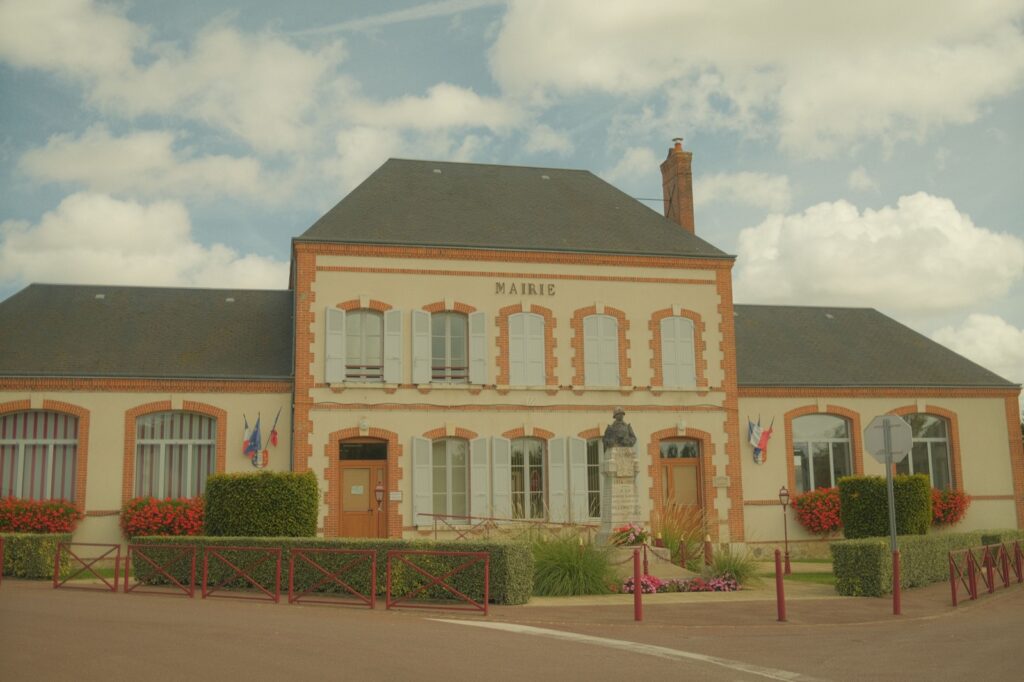
French Civic Test 2026: 10 Practice Questions & Answers A French town hall (mairie). The…

Professional French Emails: Examples, Replies & Follow-Ups