

If you want to sound French, it’s not only about grammar. It’s about rhythm, melody, and small everyday expressions. These are the phrases French people say without thinking—like little keys to the culture. From “Pas de problème” to “Ça arrive,” they carry the tone of daily life in Paris cafés, Marseille markets, and Lyon offices.
Below you’ll find common French expressions, their meaning, and how to pronounce them naturally. And because speaking is a muscle, I’ll show you how to train your mouth by recording yourself. Finally, we’ll talk about personality: why French people often sound less enthusiastic than Americans, and how their language reflects it.
- Expressions to Sound French in Everyday Life & Audio Recordings
- French Pronunciation: Train Your Ear, Not Your Eyes
- Train Your Mouth in French: Record Yourself Like a Gym Session
- French Personality in Expressions
- FAQs About Everyday French Expressions to Sound Native
- Speak French the French Way
- Exercise: Texte à trous avec des expressions françaises
- Everyday French Expressions: Common Questions
- Build the Life You’ve Dreamed of in France.
Expressions to Sound French in Everyday Life & Audio Recordings

Pas de problème
No problem → Pa deu pro-blem
Ça fait longtemps !
Long time no see! → Sa fé lon-tan
Je ne peux pas me plaindre
I can’t complain → Jeu neu peu pa meu plèndr
C’est gentil de ta part
It’s very nice of you → Sé jan-ti deu ta parr
Qu’est-ce qu’il se passe ?
What’s happening? → Kèss kil se pass ?
Ne t’inquiète pas
Don’t worry → Neu tain-kièt pa
Ne prends pas cela trop à cœur
Don’t take it to heart → Neu pran pa s’la tro a keur
Pardon, je n’ai pas compris
Sorry, I didn’t understand → Par-don, jeu n’é pa kom-pri
Pardon, j’étais dans mes pensées
Sorry, I was daydreaming → Par-don, j’é-tè dan mé pan-sé
Ça n’a pas d’importance
It doesn’t matter → Sa na pa dam-por-tanss
On croise les doigts !
Crossed fingers! → On kroaz lé dwa
Ceci explique cela
That explains a lot → Seu-si eks-plik seu-la
Ça arrive
It happens → Sa a-riv
Excuse-moi de te déranger
Sorry to bother you → Eks-kuz mwa deu teu dé-ran-jé
Je suis à toi / vous dans une minute
I’m with you in a minute → Jeu swi a twa / vou dan zune mi-nut
Où en étions-nous ?
Where were we? → Ou an né-tyon nou ?
Tu as de la chance !
You are lucky! → Tu a deu la shanss
Quelle bonne nouvelle !
What great news! → Kèl bon nou-vèl
C’est super !
That’s great! → Sé su-pèr
J’ai tellement hâte !
I can’t wait! → Jé tèl-man at
C’est dommage
That’s a pity → Sé do-majj
Amuse-toi bien !
Have fun! → A-muz twa byin
Build the Life You’ve Dreamed of in France.
Join Survive & Thrive in France – my signature programme combining practical French, cultural confidence, and a welcoming community to help you truly feel at home in France.
French Pronunciation: Train Your Ear, Not Your Eyes
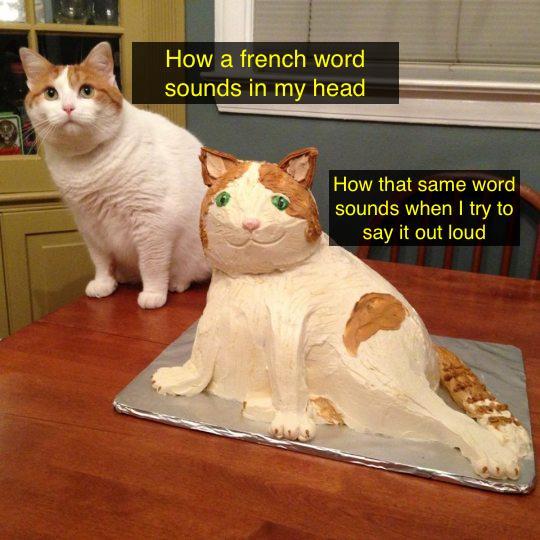
As you may already know by now, French spelling is a cruel joke. It looks elegant on paper, but when you open your mouth, half the letters vanish like ghosts. Beaucoup has six letters and you only say three. Qu’est-ce qu’il se passe ? looks like a crossword puzzle but actually sounds like Kèss kil se pass ?.
That’s why I tell my students: trust your ears, not your eyes. Watch a French Netflix series without subtitles for five minutes. You won’t get every word, but your brain will start to catch the rhythm. And yes, you’ll laugh at how far the sounds drift from the spelling.
A great hack: take a green pen and write the pronunciation under the words. It’s like giving yourself subtitles. Suddenly garçon becomes gar-son, and life feels less unfair.
Here’s a cheat sheet for the combos that French people hide behind:
- -er, -ez, -ait, -aient → all sound like é (café, parlé, vous parlez… always é)
- -ent (at the end of verbs) → silent (ils parlent = il parl)
- -tion → sion (attention = atansion)
- au / eau → o (beau = bo)
- ou → oo (bonjour = bon-zhoor)
- oi → wa (moi = mwa, trois = trwa)
- gn → ny (champagne = shan-pany)
- ch → sh (chat = sha)
- ill → often y (famille = fa-mee-y)
- ç → s (garçon = gar-son)
And then come the nasal sounds — the ones that make you pinch your nose like a mime:
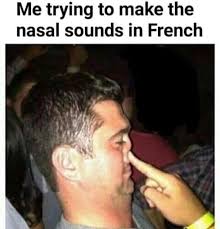
- an / en / em → ã (sans = sã)
- on / om → õ (nom = nõ)
- in / im / ain / ein → ẽ (pain = pẽ)
- un → the odd one out, somewhere between in and on (un vin = ẽ vẽ)
So yes, French is a puzzle. But if you use your green pen, repeat out loud, and listen without reading, you’ll start sounding less like Google Translate and more like someone who actually lives in Lyon.
Train Your Mouth in French: Record Yourself Like a Gym Session

Speaking French is physical. Your lips round more, your tongue presses differently, your jaw moves less. The best way to improve is to record yourself. Pick three expressions like Pas de problème, Ça arrive, Amuse-toi bien and say them five times each. Then listen back. Compare with a native recording on YouTube or a podcast.
Think of it like a workout plan: repetition builds muscle memory. Soon, “Ne t’inquiète pas” will flow out naturally, without effort.
French Personality in Expressions

French people often sound less enthusiastic than Americans. It’s not coldness, it’s style. Where an American might say “That’s amazing!” the French will go with a calm C’est super.
A phrase like Je ne peux pas me plaindre (“I can’t complain”) says a lot. It reflects a modest attitude, an everyday realism. Another example: Ça arrive (“It happens”). Simple, almost resigned, but full of meaning.
Expressions are not just words. They’re a window into French culture: a touch of irony, restraint, and balance.
FAQs About Everyday French Expressions to Sound Native
How do I learn to pronounce French expressions?
Record yourself, repeat daily, and compare with native audio. Focus on rhythm more than individual letters.
Do French people use these phrases often?
Yes. Phrases like Pas de problème or Ça n’a pas d’importance are part of daily conversation in cafés, offices, and family dinners.
Why do French people sound less enthusiastic?
It’s cultural. French communication values understatement. Enthusiasm is often shown in tone, not exaggerated words.
Speak French the French Way
Expressions are shortcuts to sounding native. Practice them out loud, listen to yourself, and notice the culture behind the words. Start small: pick three phrases today and use them in a real conversation.
Your French will sound less like a textbook, more like Paris.
Exercise: Texte à trous avec des expressions françaises
Practice makes perfect. Try this short dialogue and fill in the blanks with the right French expression from the list above.
Dialogue 1 – Croiser un ami
Fill in the blanks with the right French expressions.
Marie: Salut Paul, _________ ! Je ne t’ai pas vu depuis des mois.
Paul: Oui, c’est vrai. Comment ça va ?
Marie: Pas mal. Et toi ?
Paul: _________, la vie continue.
Marie: Tu as entendu ? Sophie a trouvé un nouveau travail.
Paul: _________ ! Elle doit être contente.
Marie: Exactement. Elle m’a dit: “Ne t’inquiète pas, tout va bien se passer.”
Paul: Eh bien, _________.
Solutions
- Ça fait longtemps !
- Je ne peux pas me plaindre
- Quelle bonne nouvelle !
- On croise les doigts !
Dialogue 2 – Au café
Fill in the blanks with the right French expressions.
Serveur: Bonjour, vous avez choisi ?
Anna: Oui, un café crème, s’il vous plaît.
Serveur: Très bien. (apporte le café) Voilà.
Anna: Merci beaucoup.
Serveur: _________, madame.
Anna: Oh non, je crois que j’ai laissé mon portefeuille à la maison…
Serveur: _________, ça n’a pas d’importance, vous reviendrez demain.
Anna: Vraiment ? Merci infiniment.
Serveur: Pas de souci. _________, tout ira bien.
Anna: Vous êtes adorable !
Solutions
- Pas de problème
- Ne vous inquiètez pas
- On croise les doigts
Et voilà! I hope you liked it.
Everyday French Expressions: Common Questions
Can You Really Learn French by Watching TV Shows? (A Method That Actually Works)

Moving to France on Screen: 13 Films That Will Make You Pack Your Bags
6 Easy French Books for Beginners (with Free PDF)
Moving To France? Books & Movies to Help You Choose the Best Region

Best French Language Movies on Netflix to Learn, Laugh, and Cry in French